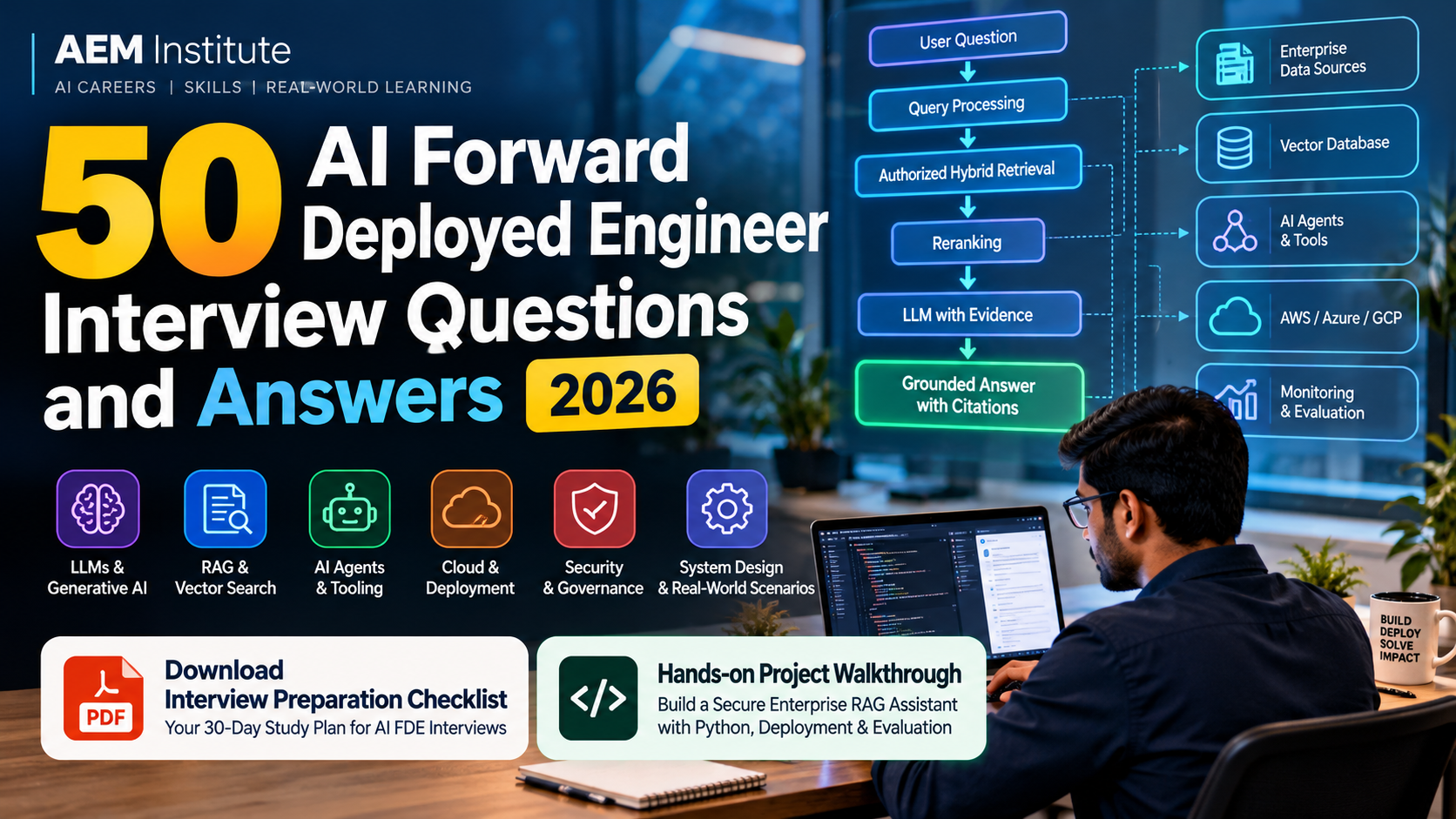
50 AI Forward Deployed Engineer Interview Questions and Answers (2026): Complete Technical & Practical Guide
AEM Institute | AI Careers & Interview Preparation | Updated October 2026
Preparing for an AI Forward Deployed Engineer (AI FDE) interview? This practical guide brings together 50 technical, system-design, security, and customer-facing interview questions with curated model answers. Learn how to explain large language models (LLMs), retrieval-augmented generation (RAG), AI agents, Python APIs, cloud deployment, evaluation, and enterprise delivery.
An AI Forward Deployed Engineer works closely with customers to turn real business problems into secure, deployable AI systems. The role blends software engineering, machine learning integration, solution architecture, and technical consulting. Interviewers often look for candidates who can build reliable applications and explain the business trade-offs behind their decisions.
Section 1: Forward Deployed Engineering Fundamentals
1. What is a Forward Deployed Engineer, and how does the role differ from a traditional software engineer?
Suggested answer: An AI Forward Deployed Engineer (FDE) works directly with customers to translate business requirements into production AI systems. Unlike a conventional product engineer focused on reusable features, an FDE often owns customer-specific integration, deployment, evaluation, and adoption. For example, a product engineer may build a document search API, while an FDE integrates it with a client’s identity provider, document permissions, and internal workflow.
2. What are the major responsibilities of an AI Forward Deployed Engineer?
Suggested answer: Responsibilities span technical discovery, data-readiness assessment, architecture, rapid prototyping, API and enterprise integration, security, deployment, monitoring, and stakeholder communication. The deliverable is not simply a model demo: it is a maintainable solution tied to measurable business outcomes.
3. How would you approach an AI project for a new enterprise customer?
Suggested answer: Start with discovery interviews and a baseline of the existing workflow. Assess data access, privacy, integrations, and failure costs. Agree on measurable acceptance criteria, build a narrow proof of concept with representative data, evaluate it, then add production controls and deploy incrementally. Close with ownership documentation, monitoring, and a feedback loop.
4. How do you decide whether a business problem actually requires AI?
Suggested answer: Compare the task against a deterministic software baseline. Rules or SQL may be preferable for fully specified logic; classical ML may suit structured prediction; LLMs help with ambiguous language and unstructured documents. Compare quality, risk, latency, operating cost, and maintainability. Choose the simplest approach that meets the acceptance criteria.
5. How would you measure the success of an enterprise AI deployment?
Suggested answer: Track business outcomes such as verified resolution rate, time saved, and cost per completed task; AI quality such as correctness and groundedness; operations such as p95 latency and availability; and adoption. Measure against a predeployment baseline, and include the cost of escalations and human corrections.
Section 2: LLMs and Generative AI Fundamentals
6. What is a Large Language Model, and how does it work?
Suggested answer: An LLM is a neural network trained to model token sequences. Many generative LLMs use decoder-only transformers and predict subsequent tokens conditioned on prior context. Pretraining develops broad language patterns; post-training can improve instruction following. Fluency does not guarantee factual correctness, so enterprise outputs need task-specific validation.
7. Explain the transformer architecture and self-attention mechanism.
Suggested answer: Self-attention projects token representations into queries (Q), keys (K), and values (V). It computes scaled query–key similarity scores, applies softmax to obtain attention weights, and uses those weights to combine the value vectors. Multi-head attention learns complementary relationships in parallel. Feed-forward layers, residual connections, normalization, and positional information help construct contextual representations. Autoregressive transformers apply causal masking so a token cannot attend to future positions.
Scaled Dot-Product Attention
Q = queries | K = keys | V = values | dk = key dimension
8. What is the difference between prompt engineering, RAG, and fine-tuning?
Suggested answer: Prompt engineering changes instructions and examples without changing model weights. Retrieval-augmented generation (RAG) supplies relevant external content at inference time, making it useful for private or frequently updated knowledge. Fine-tuning changes model parameters using training examples and may improve stable, repeated task behavior. These methods can be combined.
9. What are tokens, context windows, and temperature in LLMs?
Suggested answer: Tokens are the model’s input/output units, which may be words, fragments, or punctuation. The context window limits the amount of information the model can process in a request. Temperature, when supported, adjusts sampling concentration: lower settings usually favor higher-probability tokens. Temperature zero does not guarantee identical outputs or factual accuracy.
10. What causes hallucinations in LLMs, and how can they be reduced?
Suggested answer: Hallucinations are unsupported or incorrect generated claims. Causes include missing evidence, ambiguous prompts, irrelevant retrieved context, and weak verification. Reduce them with authoritative retrieval, explicit abstention behavior, citations, structured validation, tool-based calculations, representative evaluations, and human review for consequential decisions. RAG reduces some failure modes but does not eliminate hallucinations.
Section 3: Retrieval-Augmented Generation and Vector Databases
11. What is Retrieval-Augmented Generation (RAG)?
Suggested answer: RAG retrieves relevant information from external sources and supplies it to an LLM when generating an answer. A typical pipeline is ingestion → parsing → chunking → embedding/indexing → authorized retrieval → reranking → grounded answer with citations. It is well suited to enterprise knowledge that changes more frequently than model weights.
Enterprise RAG Architecture
12. What are embeddings, and why are they important in AI search?
Suggested answer: Embeddings represent content as numerical vectors. Compatible query and document embeddings can be compared using cosine similarity or another distance metric to find semantically related passages. Embedding proximity does not guarantee factual relevance, so combine vector retrieval with metadata filtering, keyword matching, and reranking when useful.
13. How would you choose a vector database for an enterprise RAG application?
Suggested answer: Benchmark candidate systems against your corpus and workload. Evaluate retrieval quality, p95 latency, filtering, hybrid search, multitenancy, access control, scale, backup, integrations, and total cost. PostgreSQL with pgvector can simplify an existing Postgres stack; specialized systems such as Qdrant, Milvus, or Weaviate may fit more demanding retrieval workloads.
14. What is document chunking, and how do you optimize it?
Suggested answer: Chunking splits source content into retrievable units. Fixed-size splitting is simple, but structure-aware chunking preserves headings, tables, clauses, and metadata. Evaluate chunk size and overlap against Recall@K, answer correctness, context cost, and latency. There is no universally optimal chunk size; use representative queries and documents.
15. How do you improve retrieval accuracy in a RAG system?
Suggested answer: Measure retrieval independently of generation using labeled relevant documents and metrics such as Recall@K and nDCG. Improve ingestion quality, chunk boundaries, query rewriting, hybrid lexical/vector retrieval, metadata filters, and reranking. Enforce authorization during retrieval so relevance never overrides access restrictions.
Section 4: AI Agents and Tool Orchestration
16. What is an AI agent, and how does it differ from a chatbot?
Suggested answer: A chatbot primarily exchanges conversational responses. An agent uses a model within a controlled application loop to choose actions, call tools, inspect results, and progress toward a goal. For example, a chatbot explains a refund policy; an authorized agent can check order status and prepare a refund request, subject to approval.
17. What is function calling or tool calling in an LLM application?
Suggested answer: Tool calling lets a model propose a structured function name and arguments. The application—not the model—must authenticate the user, validate arguments, authorize the operation, execute it, and return the result. A tool such as get_order_status(order_id) should not allow arbitrary database access. Add timeouts, idempotency, and audit logs.
18. How would you design a multi-agent AI architecture?
Suggested answer: Start with a single workflow baseline. Introduce specialized agents only when clear separation improves task success or maintainability. A coordinator can delegate retrieval, analysis, and authorized actions through typed contracts. Define tool permissions, handoff protocols, execution budgets, stopping conditions, and approval gates. Compare accuracy, latency, and cost against the simpler baseline.
19. What is the difference between an AI workflow and an autonomous agent?
Suggested answer: A workflow follows a mostly developer-defined sequence, even if individual steps use an LLM. An agent has more discretion to select tools or intermediate steps. Workflows are usually easier to test and audit; agents help when the next step depends on uncertain observations. Prefer constrained workflows for predictable, high-risk processes.
20. How do you prevent AI agents from performing unsafe or unauthorized actions?
Suggested answer: Apply least-privilege tool access, server-side authorization, schema validation, isolated execution, rate and spend limits, and explicit approvals for consequential actions. Treat retrieved documents and tool outputs as untrusted input to resist prompt injection. Maintain audit trails and adversarial tests; a system prompt is not a security boundary.
Section 5: Python, APIs and Backend Engineering
21. Why is Python commonly used in AI engineering?
Suggested answer: Python combines a mature data and ML ecosystem—NumPy, pandas, PyTorch, scikit-learn—with practical web tooling such as FastAPI. It is productive for experimentation and integration. Production quality still requires typing, tests, profiling, dependency controls, observability, and appropriate acceleration for compute-intensive workloads.
22. How would you build a REST API for an AI application using FastAPI?
Suggested answer: Define request and response models with Pydantic, expose a versioned endpoint, and keep model invocation in a service layer. Add authentication, input limits, timeouts, error handling, rate limiting, and tracing. A minimal example is shown below; its handler is a stub and must be replaced with an authorized model-service call.
from fastapi import FastAPI
from pydantic import BaseModel

app = FastAPI()

class QueryRequest(BaseModel):
    question: str

class QueryResponse(BaseModel):
    answer: str

@app.post("/ask", response_model=QueryResponse)
def ask(request: QueryRequest):
    # Demo stub: replace with authenticated model service.
    return QueryResponse(answer=f"Received: {request.question}")
23. How do synchronous and asynchronous programming differ in AI applications?
Suggested answer: Synchronous execution waits for an operation before continuing in that path. Async I/O lets the runtime serve other requests while awaiting network or database operations. This can improve throughput for external model APIs and retrieval calls. Async does not automatically accelerate CPU-bound inference; use profiling, process parallelism, or optimized serving as needed.
24. How would you handle API rate limits and failures in a production AI service?
Suggested answer: Classify errors as retryable or permanent. Use bounded exponential backoff with jitter for transient failures, honor Retry-After guidance, apply timeouts and concurrency limits, and expose graceful fallbacks. Ensure write operations use idempotency keys or equivalent controls before retrying. Monitor throttling, retries, and downstream latency.
25. How would you design a secure API integration between an AI agent and an enterprise CRM?
Suggested answer: Place an authenticated adapter between the agent and CRM. Enforce OAuth or equivalent identity, operation-level permissions, input validation, least-privilege scopes, and secure token storage. Return only required fields, redact sensitive logs, and require approval for consequential writes. Include auditability, pagination, retries, and idempotency.
Section 6: Cloud Architecture, Deployment and MLOps
26. How would you deploy an enterprise AI application on AWS, Azure, or Google Cloud?
Suggested answer: Design around data residency, compliance, latency, traffic, and budget. A typical deployment includes an authenticated API, container or managed compute, model endpoint, retrieval store, object storage, secret manager, and telemetry. Use Infrastructure as Code, isolated environments, CI/CD, and a rollback plan. Choose services that fit the customer’s existing cloud standards.
27. What is the role of Docker and Kubernetes in AI deployment?
Suggested answer: Docker packages an application and dependencies as a reproducible image. Kubernetes manages container scheduling, service discovery, rollout, health checks, and scaling. It can help with complex multi-service workloads but adds operational overhead. A managed container or serverless service may be preferable for smaller applications.
28. How would you implement CI/CD for an LLM-powered application?
Suggested answer: Run linting, unit and integration tests, dependency scans, infrastructure validation, and task-specific AI evaluations. Version code, prompts, model identifiers, retrieval configurations, and evaluation datasets. Use staging and progressive production rollout with quality, cost, and latency guardrails. Roll back when either software reliability or model behavior regresses.
29. How do you monitor an LLM application in production?
Suggested answer: Instrument the full request trace: authentication, retrieval, reranking, model calls, tool calls, and response. Track p50/p95/p99 latency, error rates, token consumption, cost per completed task, retrieval quality, unsupported-answer rate, and escalation outcomes. Redact sensitive data and use controlled access to traces and logs.
30. How would you reduce inference cost without significantly reducing AI quality?
Suggested answer: Measure total cost per successful task rather than token price alone. Reduce irrelevant context, improve retrieval precision, cache safe repeated results, route simple tasks to smaller models, and limit unnecessary tool loops. Benchmark each change against a fixed evaluation set; extra retries or manual correction can erase apparent savings.
Section 7: Security, Governance and Responsible AI
31. What is prompt injection, and how would you defend against it?
Suggested answer: Prompt injection occurs when untrusted content attempts to redirect the assistant from its authorized instructions. Retrieved pages, documents, and tool outputs must be treated as data, not authority. Mitigations include tool allowlists, server-side permission checks, constrained actions, output validation, approvals, sandboxing, and adversarial testing. No prompt-only defense is sufficient.
32. How do you protect personally identifiable information in AI applications?
Suggested answer: Classify data and minimize what reaches the model. Use encryption in transit and at rest, least-privilege access, secure secrets, retention limits, and controlled logging. Apply redaction or pseudonymization where appropriate. Review provider data handling, geographic processing, and relevant legal obligations before deployment.
33. What is role-based access control, and why is it important in RAG?
Suggested answer: RBAC assigns permissions based on user roles. In enterprise RAG, the retriever must enforce the requesting user’s document permissions before context reaches the model. Preserve source ACLs during indexing, filter search results, and test cross-role leakage. Storing embeddings in a shared index does not make private documents public.
34. How would you address bias and fairness in an enterprise AI solution?
Suggested answer: Identify affected groups, potential harms, and the decisions the system influences. Test representative scenarios and appropriate subgroup metrics, subject to lawful data collection. Review data sources, retrieval, prompts, and human decision points. Document trade-offs, introduce review for high-impact outcomes, and revisit the assessment as usage changes.
35. How do you ensure auditability and governance in AI systems?
Suggested answer: Version models, prompts, retrieval configurations, and deployments. Log authorized tool invocations, source identifiers, approvals, and significant decisions without exposing unnecessary personal data. Maintain evaluation evidence, risk assessments, incident procedures, access controls, and retention policies. Align controls with the organization’s governance requirements.
Section 8: System Design and Enterprise AI Scenarios
36. Design an enterprise document question-answering system for 100,000 documents.
Suggested answer: Build incremental ingestion that parses files, preserves structure and ACLs, chunks content, generates embeddings, and indexes text plus metadata. At query time authenticate, filter by permissions, use hybrid retrieval and reranking, then generate cited answers with abstention behavior. Test ingestion throughput, retrieval Recall@K, p95 latency, deletion propagation, and cross-user leakage.
37. How would you design an AI-powered customer support system?
Suggested answer: Start with bounded, low-risk intents such as policy questions and order status. Combine a permission-aware knowledge base with authenticated transactional tools and a human escalation path. Evaluate verified resolution rate, inappropriate automation, customer satisfaction, latency, and cost per resolution. Require approval or policy checks for refunds and account changes.
38. How would you build a real-time fraud detection solution using AI?
Suggested answer: Keep the low-latency decision path separate from optional LLM explanations. Use streaming features, deterministic rules, and a calibrated fraud model to produce risk scores. Set thresholds using false-positive costs, detection benefits, and regulatory constraints. Monitor precision, recall, drift, decision latency, and analyst workload.
39. How would you integrate an AI assistant with legacy enterprise systems?
Suggested answer: Inventory supported APIs, authentication, schemas, operational constraints, and data ownership. Build adapters or middleware that validate requests and preserve existing business rules. Avoid uncontrolled direct writes. Add retries, idempotency, schema contracts, audit logs, and compensation or rollback mechanisms for multi-step operations.
40. How would you design an AI application that serves thousands of concurrent users?
Suggested answer: Estimate requests per second, peak concurrency, input/output tokens, latency SLOs, and cost. Use stateless APIs, horizontal scaling, queues for long jobs, caching where safe, quotas, and bounded downstream concurrency. Load-test retrieval, model inference, and external tools separately. Plan graceful degradation when dependencies throttle or fail.
Section 9: Evaluation, Debugging and Performance Optimization
41. How do you evaluate the quality of a RAG application?
Suggested answer: Evaluate retrieval separately with Recall@K, Precision@K, or nDCG. Evaluate generation for factual correctness, evidence faithfulness, citation accuracy, and proper abstention. Use a labeled dataset with answerable, ambiguous, unanswerable, and adversarial cases. Calibrate automated graders against human judgments and track end-to-end task success.
42. What would you do if an AI application produces inconsistent answers?
Suggested answer: Reproduce failures using the same prompts, model version, retrieval snapshot, tools, and request settings. Compare traces for retrieval drift, model sampling, ambiguous instructions, and external data changes. Add schema validation, stronger evidence requirements, deterministic business rules, and regression tests. Temperature zero is not a universal determinism guarantee.
43. How would you troubleshoot high latency in an LLM application?
Suggested answer: Trace each stage and measure p50, p95, and p99. Separate queueing, retrieval, reranking, prompt assembly, time to first token, token generation, and tool latency. Optimize the dominant bottleneck: indexes, parallel independent I/O, context length, model choice, caching, or capacity. Recheck accuracy after optimization.
44. What is model drift, and how do you detect it?
Suggested answer: Drift can describe changes in input distributions or input-output relationships that degrade performance. LLM application quality may also shift when prompts, model versions, retrieved documents, or tools change. Monitor representative evaluation scores, input patterns, failure categories, and business outcomes. Diagnose the cause before retraining or changing prompts.
45. How would you conduct A/B testing for an AI feature?
Suggested answer: Define a hypothesis, primary outcome, guardrail metrics, and randomization unit. Estimate sample size, avoid cross-group contamination, and compare verified task completion, corrections, latency, and cost. Complete offline safety and quality evaluations first, then use staged rollout. Interpret results using uncertainty intervals and practical significance.
Section 10: Consulting, Stakeholder Management and Behavioral Interviews
46. A customer wants to deploy an AI solution in two weeks. How would you manage the engagement?
Suggested answer: Clarify whether the target is a demo, controlled pilot, or production launch. Identify the smallest valuable and safe scope, confirm data and security dependencies, and agree on acceptance criteria. Present a phased plan with explicit risks and owners. Do not label a prototype production-ready when required controls are missing.
47. How would you explain a complex AI architecture to a non-technical executive?
Suggested answer: Lead with the business workflow and measurable result. Describe RAG as an assistant that searches approved company information before answering. Explain safeguards such as permissions, citations, quality testing, and escalation. Discuss costs, failure modes, and expected ROI; save embedding and orchestration details for technical stakeholders.
48. What would you do if a customer rejects your proposed AI architecture?
Suggested answer: Ask which requirement the design fails: cost, residency, performance, vendor dependence, or maintainability. Separate hard constraints from preferences, document trade-offs, and benchmark feasible alternatives. For instance, compare pgvector with a managed search service on the customer’s actual workload rather than defending a preferred stack.
49. Describe how you would handle a critical production failure in an AI deployment.
Suggested answer: Follow incident procedures: assess severity and blast radius, contain unsafe behavior, restore service through rollback or fallback, and communicate status. Preserve traces without exposing sensitive data. After recovery, conduct root-cause analysis, add regression tests and guardrails, and verify corrective actions through drills or monitoring.
50. Why should we hire you as an AI Forward Deployed Engineer?
Suggested answer: A strong answer connects engineering execution with customer impact: “I translate ambiguous business requirements into secure, measurable AI solutions. I can design APIs, RAG, and agent workflows, integrate enterprise systems, evaluate quality, and operate services in production. I communicate trade-offs clearly and take ownership of outcomes.” Customize this with real projects and quantified achievements; never claim experience you do not have.
Practical case study: Design a secure enterprise AI knowledge assistant
Scenario: A multinational organization wants employees to search 100,000 internal policies, manuals, and operating procedures using natural language. Employees have different document permissions, and answers must cite their sources.
Architecture: Create an incremental ingestion pipeline that parses documents, retains source metadata and access-control lists, chunks content, and indexes both text and embeddings. Authenticate every query, enforce permissions during retrieval, rerank relevant passages, and instruct the model to cite evidence or abstain when evidence is insufficient.
Evaluation: Build a representative benchmark with answerable and unanswerable questions. Measure retrieval Recall@K, grounded answer accuracy, citation correctness, p95 latency, cost per successful answer, and unauthorized disclosure attempts.
Production readiness: Add versioning, document deletion propagation, observability, access-control regression tests, incident handling, and a human escalation path. A strong interview answer explicitly discusses trade-offs between retrieval quality, latency, security, and cost.
How to prepare for an AI Forward Deployed Engineer interview
Do not rely on memorizing definitions alone. Build at least one end-to-end project, measure its behavior, and practice explaining why you chose each component. Your portfolio should demonstrate both engineering depth and customer-oriented decision-making.
| Timeline | Focus | Deliverable |
|---|---|---|
| Days 1–7 | Python, FastAPI, LLM basics | Typed API with tests and error handling |
| Days 8–14 | Embeddings, RAG, evaluation | Document assistant with citations and retrieval metrics |
| Days 15–21 | Tool calling, security, cloud | Authorized tool workflow deployed to a cloud service |
| Days 22–30 | System design, observability, mock interviews | Architecture walkthrough and evaluation report |
Prepare examples showing how you scoped an ambiguous requirement, diagnosed a failure, managed a trade-off, and communicated an engineering decision to a non-technical stakeholder.
Frequently asked questions about AI Forward Deployed Engineer careers
Is an AI Forward Deployed Engineer the same as an AI Engineer?
Not exactly. Both roles can involve AI architecture and implementation, but an FDE usually spends more time on customer discovery, enterprise integration, and end-to-end delivery.
Does an AI FDE need deep machine learning research experience?
Not always. Many roles prioritize strong software engineering, production AI application design, and customer-facing problem solving. Some positions require deeper modeling expertise.
Is Python mandatory for Forward Deployed AI Engineering?
Python is widely useful, but requirements vary. SQL, TypeScript, Java, cloud platforms, and enterprise integration skills may also matter.
What projects should candidates include in their portfolios?
Show a secure RAG assistant, an authorized tool-using agent, or a production-style AI API with testing, deployment, tracing, and evaluation.
How difficult is an AI Forward Deployed Engineer interview?
Difficulty varies by employer and seniority. Expect combinations of coding, system design, LLM fundamentals, debugging, security, and stakeholder communication.
Final thoughts
AI Forward Deployed Engineers must do more than connect an LLM to an API. They need to understand business requirements, build dependable integrations, evaluate quality, manage security and cost, and deliver measurable outcomes. Use these 50 questions to practice explaining not just what you would build, but why the architecture is appropriate and how you would validate it in production.
Authoritative technical references
- OpenAI documentation: Evaluations
- OpenAI documentation: Function calling
- AWS technical documentation
- Google Cloud Architecture Center
- OWASP Top 10 for LLM Applications
Editorial note: This educational guide provides representative answers, not official interview questions from a specific employer. Adapt examples to your own verified experience.

AI, Cybersecurity & Agentic AI Consultant
Cloud Security Architect | DevSecOps Consultant | Certified ISO/IEC 42001 AIMS Lead Auditor | ISO/IEC 27001 ISMS Lead Auditor
With 23+ years in cybersecurity, including Cloud Security Architecture and DevSecOps consulting experience, I help organizations turn AI into a secure, responsible, and business-driven capability.
My focus spans AI Strategy, Agentic AI, Responsible AI, AI Governance, and AI Security, supported by knowledge of India’s Digital Personal Data Protection (DPDP) Act.
I help design trusted AI solutions that balance autonomy, human oversight, privacy, and accountability—connecting intelligent automation with measurable business value.
Secure AI. Responsible autonomy. Business impact.