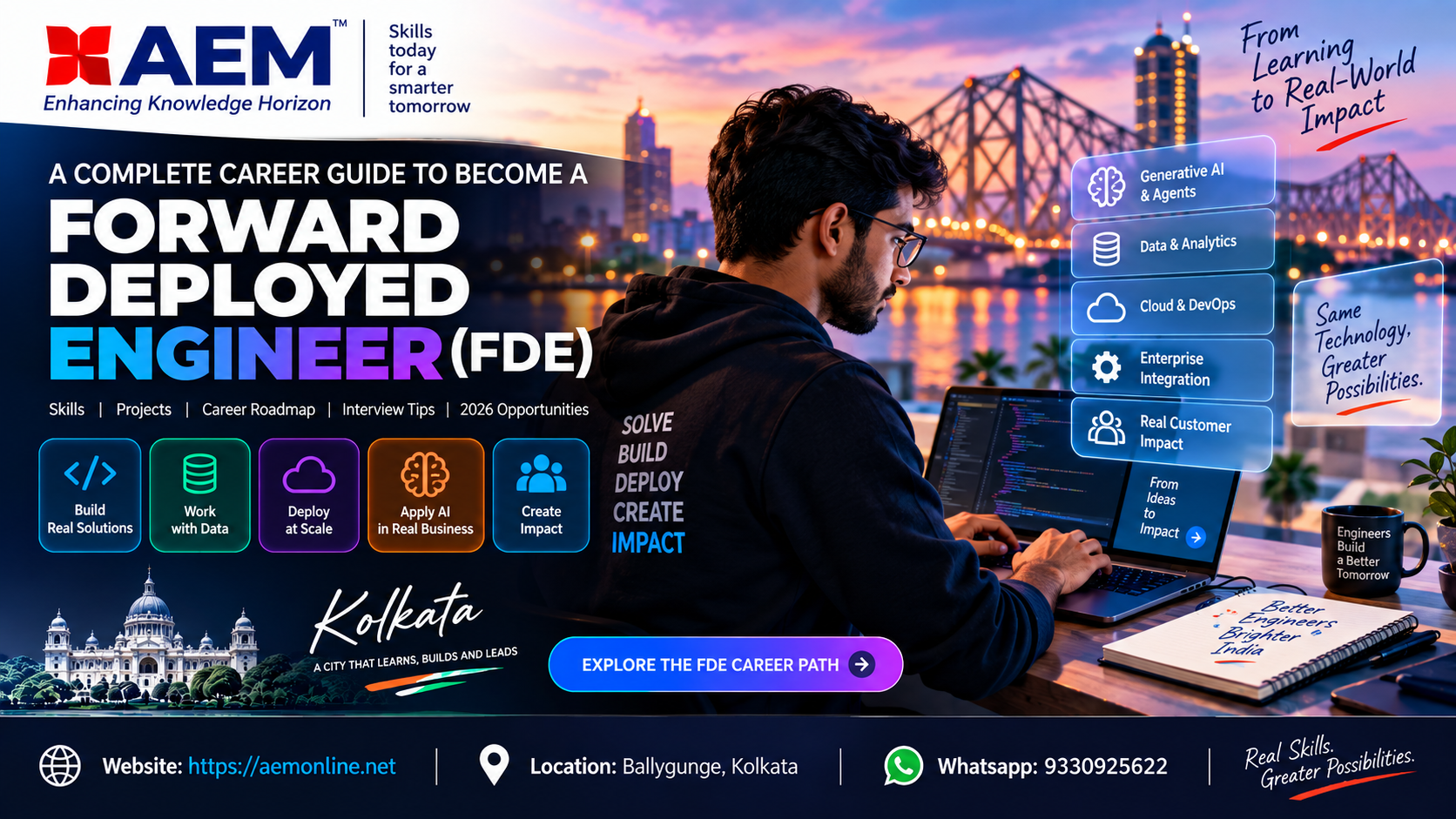
Best Forward Deployed Engineer Course in Kolkata: Complete FDE Career Guide for 2026
Forward Deployed Engineering is emerging as one of the most interesting career directions for software developers, AI engineers, data professionals, cloud engineers, DevOps professionals and technical consultants in 2026.
But what exactly does a Forward Deployed Engineer (FDE) do?
An FDE works at the intersection of software engineering, AI, data, cloud infrastructure and customer problem-solving. Instead of receiving perfectly defined requirements and working only on one product component, Forward Deployed Engineers often enter complex business environments, discover the real problem, design the solution, build and integrate it, take it into production and help ensure that it creates measurable value.
That combination makes FDE particularly relevant in the age of enterprise AI.
For technical professionals searching for the Best Forward Deployed Engineer Course in Kolkata, the important question is therefore not simply which tools or certifications a course provides.
The better question is:
Can the learning path prepare you to solve ambiguous business problems using production-grade software, data, cloud and AI engineering?
This AEM Institute guide explains the skills, projects, career roadmap and interview preparation required to work toward becoming a Forward Deployed Engineer in 2026.
What Is a Forward Deployed Engineer?
A Forward Deployed Engineer (FDE) is a technically strong engineer who works closely with customers or internal business teams to convert complex requirements into working technology solutions.
The easiest way to understand the role is through ownership.
A conventional software engineer may own a particular capability within a product.
A Forward Deployed Engineer is more likely to own the technical outcome surrounding a customer problem.
Consider an enterprise that says:
“We want an AI assistant for our operations team.”
An FDE should not immediately start building a chatbot.
The engineer first investigates:
- What problem is the operations team actually experiencing?
- How is the workflow performed today?
- Which systems and databases contain the required information?
- What should AI automate—and what should remain under human control?
- What security or compliance restrictions exist?
- How will the new system integrate with existing applications?
- What measurable result would make the project successful?
Only then should architecture and development begin.
A useful definition is:
Forward Deployed Engineering is the practice of turning ambiguous business problems into measurable outcomes through hands-on software, data, cloud and AI engineering.
That ability—not simply knowledge of a particular framework—is the foundation of the role.
Why Forward Deployed Engineering Matters in 2026
Modern enterprises have unprecedented access to technology.
Cloud platforms, foundation models, AI agents, APIs, vector search, analytics platforms and developer tools can make prototypes remarkably fast to create.
But there is an enormous difference between a successful demonstration and a reliable enterprise system.
A production solution must work with existing databases, authentication systems, APIs, permissions, business rules, security controls, infrastructure and human workflows.
It must also survive incomplete data, changing requirements, unreliable external services and real users.
This creates a critical gap:
Technology Capability → Enterprise Deployment → Business Outcome
Forward Deployed Engineers operate inside that gap.
Their value is not simply demonstrating what technology can do.
Their job is making technology work in the real environment where value has to be created.
This becomes especially important with Generative AI and Agentic AI. Building an AI prototype has become easier; integrating, evaluating, securing and operating AI inside an enterprise remains difficult.
FDE vs Software Engineer vs AI Engineer vs Solutions Engineer
Forward Deployed Engineering overlaps with several established technology roles, but the scope of ownership is different.
| Role | Primary Focus |
|---|---|
| Software Engineer | Building and maintaining software products and capabilities |
| Data Engineer | Building reliable data pipelines and platforms |
| AI/ML Engineer | Developing models and AI-enabled systems |
| DevOps/Platform Engineer | Infrastructure, deployment and operational reliability |
| Solutions Engineer | Connecting technical capabilities with customer requirements |
| Forward Deployed Engineer | Delivering an end-to-end technical outcome in a customer or business environment |
An FDE may therefore write Python code, investigate SQL data, design an API integration, configure cloud infrastructure, build an AI workflow and explain architectural trade-offs to business stakeholders—all within the same project.
That breadth is precisely what makes the role demanding.
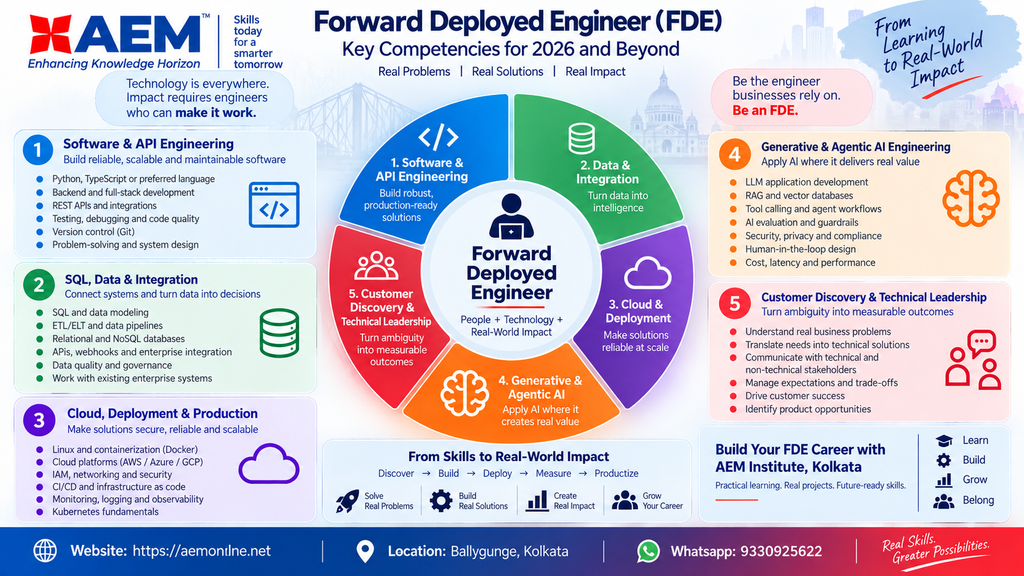
The 5 Core Forward Deployed Engineer Skills for 2026
There is no universal FDE technology stack.
Different employers use different languages, cloud platforms, AI models and deployment architectures.
Trying to learn every tool is therefore the wrong strategy.
Instead, aspiring FDEs should develop a T-shaped skill profile: strong engineering depth combined with enough breadth to navigate unfamiliar systems.
1. Software and API Engineering
Forward Deployed Engineers must first be capable engineers.
For AI-oriented roles, Python is particularly useful because it spans backend development, automation, data processing and AI applications.
JavaScript or TypeScript is valuable for full-stack development. Depending on the enterprise environment, Java, .NET or Go may also be useful.
More important than collecting programming languages is developing the ability to:
- build maintainable applications;
- design and consume REST APIs;
- work with authentication and authorization;
- write tests;
- debug unfamiliar systems;
- handle errors, retries and asynchronous processes;
- use Git effectively; and
- make sensible engineering trade-offs.
A strong FDE should be comfortable moving from an ambiguous requirement to working software—and from a production failure back to a stable system.
2. SQL, Data and Integration
Many apparently “AI” problems eventually become data and integration problems.
A powerful model cannot compensate for missing, inaccessible or contradictory enterprise data.
Strong SQL skills are therefore highly valuable.
Aspiring FDEs should understand:
joins, aggregations, CTEs, window functions, indexing, query performance and relational data modeling.
They should also understand the larger data lifecycle:
Source → Ingestion → Transformation → Storage → Retrieval → Application → User
Knowledge of ETL/ELT, data quality, schemas, relational and NoSQL systems, warehouses or lakehouses, and scalable processing becomes useful depending on the project.
Integration deserves equal attention.
Enterprise environments contain CRMs, ERPs, SaaS platforms, internal databases, legacy applications, identity systems and third-party APIs.
That makes practical knowledge of REST APIs, webhooks, OAuth, JWT, service accounts, rate limits, retries, queues and event-driven integrations extremely valuable.
The objective is not memorizing technologies.
It is becoming capable of entering an unfamiliar technical environment and determining:
Where does the truth live, how does it move, and where is it breaking?
3. Cloud, Deployment and Production Engineering
An application running on a developer’s laptop is not a production deployment.
Forward Deployed Engineers frequently need to make software operate reliably inside environments they did not design.
Technical professionals should therefore build practical knowledge of:
- Linux;
- Docker;
- cloud computing;
- networking fundamentals;
- IAM;
- databases and storage;
- secrets management;
- CI/CD;
- logging;
- monitoring;
- observability; and
- Kubernetes fundamentals where appropriate.
Choose one major cloud platform—AWS, Microsoft Azure or Google Cloud—and develop genuine competence before trying to learn everything.
The important engineering lifecycle is:
Build → Test → Package → Deploy → Observe → Diagnose → Recover
Understanding that lifecycle is more valuable than memorizing dozens of cloud services.
4. Generative AI and Agentic AI Engineering
For AI-focused Forward Deployed Engineering in 2026, knowing how to call an LLM API is only the beginning.
Professionals increasingly need to understand AI systems engineering.
Important areas include:
LLM Application Development: integrating foundation models into applications and workflows.
Retrieval-Augmented Generation (RAG): retrieving relevant enterprise information and providing it as context to models.
Tool Calling: allowing models to interact with APIs, databases and business applications.
Agentic AI: designing systems capable of performing multi-step workflows using tools and external systems.
Evaluation: measuring whether AI outputs actually satisfy the required standard.
Guardrails and Security: controlling data access and potentially risky actions.
Observability: understanding what happened when an AI workflow produces an incorrect result.
Cost and Latency: balancing model quality with operational economics.
Human-in-the-Loop Design: determining where people should review, approve or override AI actions.
The most important principle is simple:
The objective of an FDE is not to use AI. The objective is to solve the problem—and use AI only where it improves the solution.
5. Customer Discovery, Architecture and Technical Leadership
This is the capability that distinguishes Forward Deployed Engineering from many conventional engineering positions.
An FDE may need to communicate with developers, security teams, operations managers and senior business leaders during the same engagement.
Suppose a customer says:
“We want an AI agent to automate our claims process.”
A weak response is:
“We can build that with RAG and an agent framework.”
A stronger FDE begins discovery:
What percentage of claims should be automated?
Which decisions require human approval?
Where is the claims data stored?
Which regulations and security policies apply?
What happens if the system makes an incorrect decision?
Which existing application records the final action?
What measurable improvement should the system create?
The FDE has transformed a vague idea into an engineering problem.
That ability to turn ambiguity into measurable requirements is one of the most important skills in the profession.
How a Forward Deployed Engineer Actually Works
A practical FDE operating model can be summarized as:
Discover → Define → Design → Build → Deploy → Measure → Productize
Discover
Understand the users, workflow, business objective, data, systems and constraints.
Define
Turn the problem into measurable success criteria.
“Use AI to improve customer service” is not a sufficient requirement.
“Reduce the time agents spend locating approved policy information while maintaining required accuracy and human controls” is much closer.
Design
Choose the simplest architecture capable of meeting the requirement.
Build
Prototype rapidly enough to test important assumptions, then develop the required software and integrations.
Deploy
Productionize the solution with appropriate security, testing, monitoring and operational controls.
Measure
Determine whether the solution actually changed the target business or user outcome.
Productize
Ask an important final question:
What did we learn from this deployment that should become reusable?
Excellent FDEs don’t simply create endless customer-specific implementations. They identify recurring patterns and help convert field learning into better platforms, products and deployment practices.
What Does a Real FDE Project Look Like?
Imagine a logistics company whose operations team spends significant time investigating delayed shipments.
The initial request might be:
“Build an AI chatbot for shipment problems.”
An FDE investigates and discovers that information is distributed across:
- shipment databases;
- carrier APIs;
- warehouse events;
- customer communication;
- operational documents; and
- a ticketing system.
The actual requirement becomes:
Create an operations assistant that assembles shipment context, retrieves the appropriate procedures, recommends the next action and—with appropriate authorization—updates the operational workflow.
Suddenly the project involves:
Python + SQL + APIs + authentication + enterprise data + retrieval + LLMs + tool calling + cloud deployment + evaluation + logging + human approval + user experience.
That is Forward Deployed Engineering.
The engineer owns the technical chain connecting business problem to production outcome.
How to Become a Forward Deployed Engineer in 2026
There is no single path into FDE.
Software engineers, data engineers, DevOps professionals, AI engineers, solutions engineers and technical consultants can all transition toward the role.
A practical six-month roadmap could look like this:
| Stage | Focus | Target Outcome |
|---|---|---|
| Month 1 | Python, Git, Linux, APIs, testing | Build a reliable backend application |
| Month 2 | SQL, databases, data modeling, pipelines | Build a data-driven application |
| Month 3 | Docker, cloud, IAM, CI/CD, observability | Deploy and operate the application |
| Month 4 | LLMs, RAG, tool calling, AI evaluation | Build an AI-enabled workflow |
| Month 5 | Agents, security, enterprise integrations, reliability | Productionize the workflow |
| Month 6 | Architecture, customer discovery, system design, FDE case studies | Complete an end-to-end FDE capstone |
The objective should not be completing six months of tutorials.
Every stage should produce something you can build, deploy, demonstrate and explain.
Build an FDE Portfolio, Not a Collection of Certificates
One of the strongest ways to prepare for Forward Deployed Engineering is to build projects that resemble real technical engagements. Three projects can provide a strong progression from application development to enterprise integration and production-grade AI.
Data-to-Decision Application
Take messy operational data and build an application that helps a user make a measurable decision.
- Model and clean real-world data
- Expose useful information through APIs
- Create a practical decision interface
- Deploy the application for real usage
Enterprise Integration System
Connect multiple systems and make them work reliably as one operational workflow.
- Authentication and authorization
- Retries and failure recovery
- Logging and monitoring
- Enterprise API and data integration
Production-Grade Agentic AI Workflow
Build an AI system that retrieves enterprise information, invokes tools, interacts with APIs, maintains workflow state, requests human approval and records its actions.
- Tool calling and workflow orchestration
- Human-in-the-loop approvals
- Security, observability and evaluation
- Production deployment and measurable outcomes
Your advanced project should bring together software, data, cloud, AI, security, integration and business reasoning. That is much stronger evidence of FDE readiness than another generic chatbot project or a long collection of certificates.
Make Your GitHub Demonstrate Engineering Judgment
Your portfolio should explain more than what you built.
For every serious FDE project, document:
Problem → Users → Success Metric → Architecture → Trade-offs → Security → Evaluation → Deployment → Observability → Lessons
Explain why you chose the architecture.
Document alternatives you rejected.
Show how authentication and permissions work.
Explain what happens when an external API fails.
Describe how you evaluated the AI component.
Show how the application is deployed and monitored.
A technical interviewer should be able to inspect the repository and see evidence not merely of coding ability, but of engineering judgment and ownership.
Who Can Transition into Forward Deployed Engineering?
FDE can be particularly attractive to experienced technical professionals because previous specialization often becomes an advantage.
Software Developers
You already have a strong foundation. Add cloud, enterprise data, AI integration, system design and customer discovery.
Data Engineers
Your knowledge of enterprise data is valuable. Strengthen application engineering, APIs, AI systems and customer-facing delivery.
DevOps and Cloud Engineers
You understand production infrastructure. Add deeper software development, data, AI and business problem-solving.
AI/ML Engineers and Data Scientists
Add backend engineering, enterprise integration, deployment, security and production ownership.
Solutions Engineers
Your customer-facing experience is valuable. Increase production coding, architecture and debugging depth.
Technical Consultants
You may already understand stakeholders and ambiguity. Strengthen your ability to personally build and deploy the solution.
The strongest FDE candidates often combine depth from one discipline with meaningful capability across several others.
AEM Institute Enquire on WhatsAppCan Freshers Become Forward Deployed Engineers?
Freshers can certainly begin preparing for FDE, but expectations should remain realistic.
Many true Forward Deployed Engineer positions require independent technical judgment in complex customer environments. Previous production engineering experience can therefore be valuable.
For an early-career professional, roles such as:
Software Engineer, Backend Developer, Data Engineer, Cloud Engineer, AI Engineer, Platform Engineer, Implementation Engineer or Solutions Engineer
can provide useful foundations.
The objective should be to develop FDE capability, even if your first job does not carry the FDE title.
How to Prepare for Forward Deployed Engineer Interviews
There is no universal FDE interview process. Different organizations emphasize different technical capabilities.
However, preparation should generally cover four areas.
Coding
Be prepared to demonstrate practical software engineering, particularly in your strongest programming language.
System Design
Practice designing systems around real constraints.
Discuss:
data flow, APIs, authentication, security, scalability, reliability, observability, cost, failure modes and trade-offs.
Customer Problem-Solving
Do not immediately propose technology when presented with an ambiguous scenario.
Start with:
Business Objective → User → Existing Workflow → Constraints → Data → Systems → Success Metric
Then design.
Behavioural Ownership
Prepare examples where:
- requirements changed;
- a deployment failed;
- stakeholders disagreed;
- you challenged an assumption;
- you worked with incomplete information; or
- customer feedback forced you to redesign something.
Interviewers need evidence that you can maintain technical judgment under ambiguity.
A useful framework is:
Diagnose → Outcome → Options → Ownership
Diagnose the problem, establish the desired outcome, explain possible approaches and trade-offs, then recommend and own the next step.
Best Forward Deployed Engineer Course in Kolkata: What Should You Look For?
Technical professionals evaluating a Forward Deployed Engineer course in Kolkata should not judge programs simply by the number of technologies mentioned in the syllabus.
Ask whether the learning path develops the following abilities:
Can you build production-grade software?
The curriculum should go beyond notebooks and demonstrations.
Can you work confidently with data?
SQL, databases, data modeling and pipelines should be practical skills.
Can you integrate systems?
APIs, authentication and enterprise integration should appear throughout the learning journey.
Can you deploy what you build?
Cloud, Docker, CI/CD, logging and monitoring should be part of development—not separate theoretical modules.
Can you engineer AI systems rather than just call an LLM?
RAG and Agentic AI should include evaluation, tool integration, security, reliability and human oversight.
Can you solve ambiguous problems?
Projects should require discovery, architecture and technical judgment.
Can you explain your decisions?
An FDE must communicate architecture and trade-offs to both technical and non-technical stakeholders.
Can you demonstrate a credible portfolio?
Training should ultimately result in applications, deployments, architecture documentation and project stories that can be discussed during interviews.
These are more meaningful criteria for identifying the best FDE training in Kolkata than certificates or long lists of tools.
Building FDE Skills with AEM Institute in Kolkata
Forward Deployed Engineering sits at the convergence of several technical disciplines.
AEM Institute’s technology learning ecosystem in Kolkata spans areas relevant to that convergence, including Artificial Intelligence, Agentic AI, Python, cloud computing, DevOps, Kubernetes, data technologies and enterprise-oriented technical skills.
For professionals exploring a Forward Deployed Engineer learning path, these capabilities should not be treated as disconnected subjects.
They need to come together around one objective:
Learn to take a complex problem from discovery to a working production solution.
That means progressing beyond:
Learn → Practice → Certify
toward:
Discover → Build → Integrate → Deploy → Troubleshoot → Explain → Improve
For working software developers, cloud engineers, DevOps professionals, data engineers and AI professionals in Kolkata, this multidisciplinary approach can provide a practical foundation for developing FDE-oriented capabilities.
Professionals considering Forward Deployed Engineer training in Kolkata can explore AEM Institute’s relevant AI, cloud, data and engineering learning pathways and evaluate them against the FDE competency framework outlined in this guide.
Frequently Asked Questions About Forward Deployed Engineering
What is a Forward Deployed Engineer?
A Forward Deployed Engineer is a technically strong engineer who works close to customers or business teams to discover problems, design solutions, build and integrate software, deploy it and own the resulting technical outcome.
What does FDE stand for?
In this career context, FDE stands for Forward Deployed Engineer, while FDE can also refer more broadly to Forward Deployed Engineering.
Is Forward Deployed Engineering an AI career?
Not exclusively. However, many modern FDE roles involve Generative AI, LLM applications, enterprise data, Agentic AI and cloud deployment because organizations need engineers capable of turning AI capabilities into working production systems.
What programming language should an FDE learn?
Python is highly useful for AI, data, automation and backend development. TypeScript or JavaScript is valuable for full-stack applications. Enterprise environments may also use Java, .NET or Go. Engineering depth and adaptability matter more than collecting languages.
Do Forward Deployed Engineers need cloud and DevOps skills?
Cloud and production engineering knowledge is highly valuable because FDEs often need to deploy and operate solutions in real enterprise environments. Docker, IAM, CI/CD, observability and one major cloud platform provide a strong foundation.
Can a software developer, DevOps engineer or data engineer become an FDE?
Yes. Each already possesses part of the FDE skill stack. The transition generally involves retaining that technical depth while developing the missing capabilities across software, data, cloud, AI, enterprise integration and customer problem-solving.
Is certification enough to become a Forward Deployed Engineer?
No. Certification can demonstrate structured learning, but FDE hiring ultimately requires evidence of engineering ability, architecture, deployment, problem-solving, communication and ownership. A strong portfolio is therefore important.
What should I look for in the Best Forward Deployed Engineer Course in Kolkata?
Look for practical coverage of software engineering, Python, SQL, APIs, cloud, Docker, AI/LLM systems, Agentic AI, security, observability, architecture, customer discovery and end-to-end projects. Most importantly, determine whether the training teaches you to solve and deploy real problems rather than simply follow tutorials.
Final Word: Build FDE Capability, Not Just an FDE Resume
Forward Deployed Engineering represents something larger than another technology job title.
It reflects an increasingly important form of engineering ownership.
The high-value engineer of 2026 is not necessarily the professional who has memorized the greatest number of frameworks.
It is the engineer who can enter uncertainty and create clarity.
Who can move between code and conversation.
Between databases and business processes.
Between an AI prototype and a secure production system.
Between architecture and execution.
And between customer problems and measurable outcomes.
For professionals searching for the Best Forward Deployed Engineer Course in Kolkata, that should be the benchmark.
Don’t ask only:
“Which technologies will I learn?”
Ask:
“What will I be capable of owning after I learn them?”
The ultimate goal is to develop enough technical depth, adaptability and business understanding to say:
Give me an ambiguous business problem and a complex technical environment. I can discover what matters, design the solution, build it, deploy it, explain the trade-offs and own the outcome.
That is the Forward Deployed Engineer mindset.
And in 2026, it is a capability worth building.

AI, Cybersecurity & Agentic AI Consultant
AI & Cybersecurity Consultant | Agentic AI & AI Strategy | Responsible AI & AI Ethics | AI Governance | AI Security | Trusted Autonomous Business Solutions | Technology Mentor
With 23+ years of experience in cybersecurity and a growing focus on Artificial Intelligence, Responsible AI, and Agentic AI, I help organizations navigate the intersection of technology, business innovation, security, ethics, and risk.
My consulting focus is evolving from securing infrastructure to helping organizations securely and responsibly adopt AI as a business capability.
I advise organizations on designing and implementing AI-powered and agentic business solutions that can reason, orchestrate workflows, interact with enterprise systems, and execute tasks with appropriate levels of autonomy—while maintaining security, governance, transparency, accountability, and human oversight.
AI Strategy, Ethics & Governance
I help organizations establish practical frameworks for Responsible AI and AI Ethics, addressing questions that go beyond technical performance:
How should AI systems make decisions—and when should humans remain in control?
How do we ensure fairness, transparency, explainability, and accountability?
How do we protect sensitive data and intellectual property when using AI?
How do we manage AI hallucination, model risk, bias, and unintended outcomes?
How do we govern autonomous AI agents operating across enterprise systems?
How do we establish AI policies, controls, risk assessments, and governance models that enable innovation rather than restrict it?
My approach connects AI Ethics, AI Governance, Cybersecurity, Privacy, Risk Management, and Business Strategy into a unified Responsible AI framework.
Agentic AI & Business Transformation
A major area of my consulting interest is Agentic AI—moving beyond conversational AI toward intelligent systems capable of planning, reasoning, collaborating, using tools, and executing multi-step business processes.
I help organizations explore and architect agentic solutions for areas such as:
AI-powered Security Operations and Autonomous SOC
Intelligent incident investigation and response
Enterprise knowledge and decision-support systems
AI-driven IT operations and automation
Customer service and intelligent service orchestration
Business process automation
Risk, compliance, and audit intelligence
Cyber threat intelligence and autonomous analysis
AI-powered enterprise assistants and multi-agent systems
Security and compliance agents integrated into DevSecOps
AI agents for operational and executive decision support
The emphasis is not simply on deploying an AI agent, but on designing an enterprise-grade agentic architecture with the right balance of autonomy, human-in-the-loop controls, security, observability, governance, and measurable business value.
AI Security & Cybersecurity
My cybersecurity background provides the foundation for approaching AI from an adversarial and risk perspective.
I focus on securing the AI lifecycle and AI-enabled enterprise, including:
AI Security → Model Security → Data Security → Agent Security → Identity → Tool/API Security → Runtime Protection → Monitoring → Governance
This includes emerging areas such as AI threat modeling, adversarial AI/ML, prompt injection, model abuse, AI supply-chain risk, agentic AI security, identity and access management for AI agents, and AI-assisted security operations.
Cloud, DevSecOps & AI Engineering
My experience across AWS, Azure, GCP, Kubernetes, IAM, Linux/Windows security, Terraform, GitLab CI/CD, OPA, Checkov, SIEM, digital forensics, and security automation allows me to connect AI initiatives with the underlying enterprise technology ecosystem.
I help bridge the gap between:
Business Strategy ↔ AI Strategy ↔ Agentic AI ↔ Cybersecurity ↔ Governance ↔ Cloud ↔ DevSecOps
My Consulting Mission
I believe the next generation of enterprise transformation will not be defined simply by adopting AI—it will be defined by how responsibly, securely, ethically, and intelligently organizations operationalize AI.
My mission is to help organizations move from:
AI Experimentation → AI Adoption → AI Governance → Agentic AI → Responsible Autonomous Business
while ensuring that human values, business objectives, security, and accountability remain at the center of intelligent automation.
I help organizations turn AI from an emerging technology into a trusted, governed, and business-driven capability.
AI Strategy | Responsible AI | AI Ethics | AI Governance | Agentic AI | AI Security | Cybersecurity Transformation | Cloud & DevSecOps