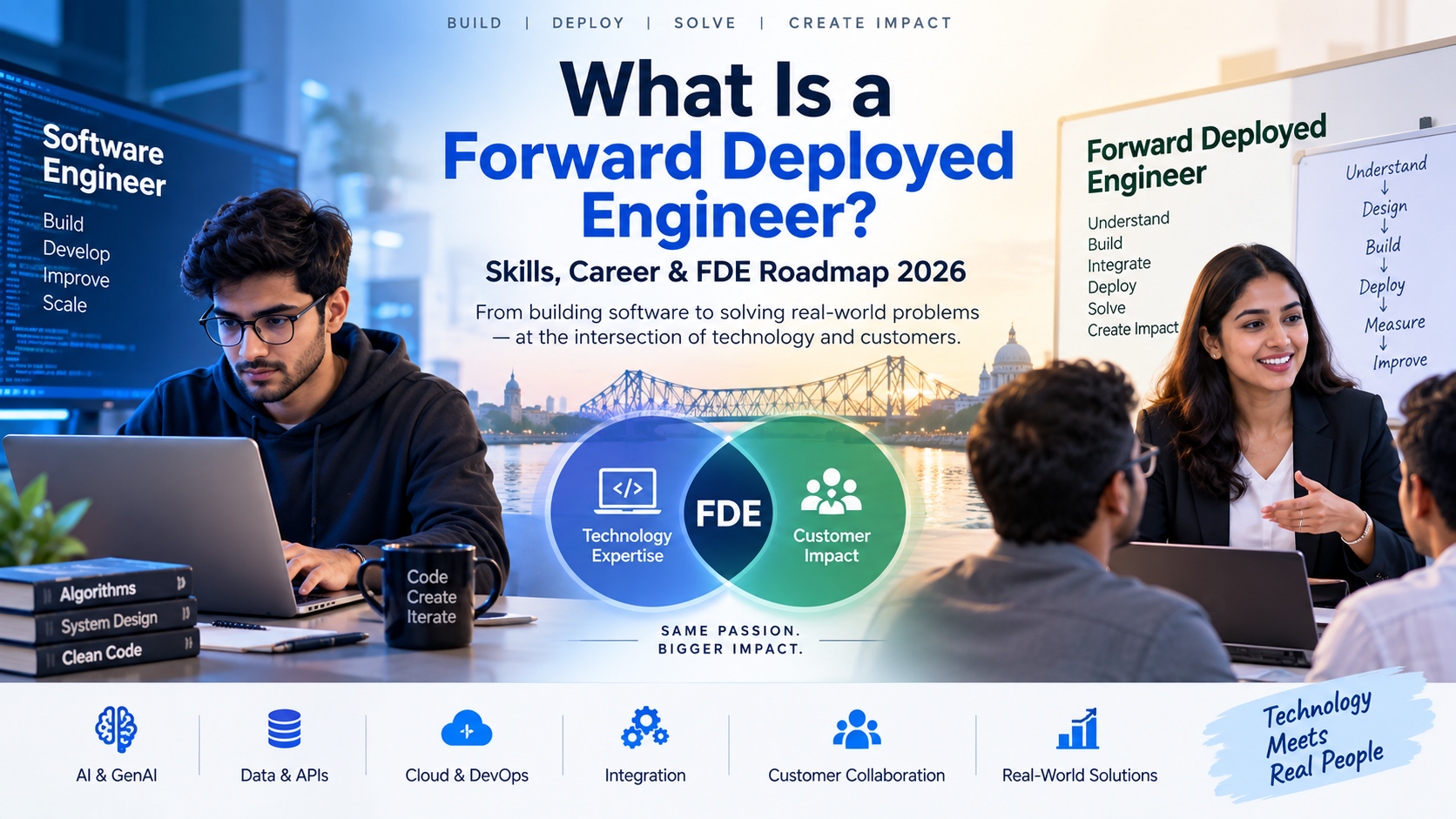
What Is a Forward Deployed Engineer? Skills, Career & FDE Roadmap 2026
Artificial Intelligence is changing not only how software is built but also how technology companies deliver solutions to customers. One role gaining attention in this environment is the Forward Deployed Engineer (FDE).
A Forward Deployed Engineer works at the intersection of software engineering, artificial intelligence, cloud technology, data, and customer problem-solving. Instead of working exclusively on an internal product, an FDE works closely with customers to understand real business problems, build technical solutions, deploy them into real environments, and improve those solutions based on actual usage.
For software developers, AI engineers, cloud professionals, and technical consultants, Forward Deployed Engineering is an emerging career path worth understanding.
This guide explains what a Forward Deployed Engineer does, the skills required, the technologies an FDE should learn, career opportunities in India, and a practical roadmap for becoming one in 2026.
What Is a Forward Deployed Engineer?
A Forward Deployed Engineer (FDE) is a technically skilled engineer who works directly with customers to design, build, integrate, and deploy software or AI solutions for complex business problems.
Unlike a conventional software engineer who may primarily work within a product development team, a Forward Deployed Engineer frequently operates closer to the customer.
The role combines elements of:
- Software engineering
- AI and Generative AI
- Solution architecture
- Data engineering
- Cloud and DevOps
- API integration
- Technical consulting
- Product thinking
- Customer communication
An FDE therefore needs more than programming knowledge. The engineer must be capable of understanding an ambiguous business requirement and converting it into a reliable technical solution.
What Does a Forward Deployed Engineer Do?
The responsibilities of an FDE vary by organization and project, but the fundamental objective is straightforward:
Understand a customer’s problem and engineer a solution that works in the real world.
A typical Forward Deployed Engineer may work through a cycle such as:
Discover → Define → Design → Build → Deploy → Measure → Improve
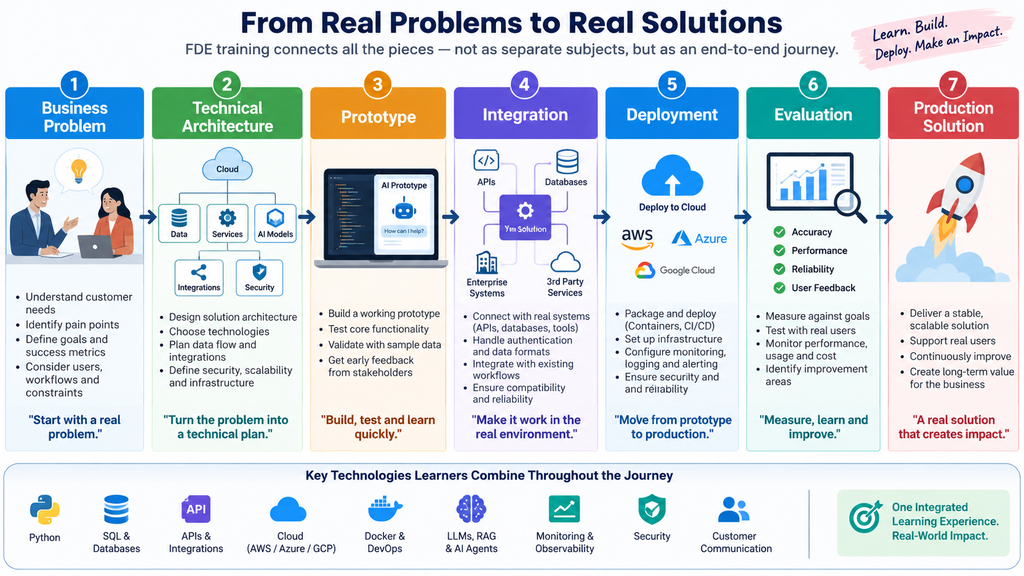
For example, imagine a company wants an AI system that can search thousands of internal documents and answer employee questions.
A Forward Deployed Engineer may need to:
- Understand how employees currently search for information.
- Identify relevant databases, documents, APIs, and security requirements.
- Design the technical architecture.
- Build a prototype using an LLM and Retrieval-Augmented Generation (RAG).
- Connect the solution with existing enterprise systems.
- Deploy the application to a cloud environment.
- Test accuracy, latency, security, and reliability.
- Collect feedback from users.
- Improve the system and prepare it for production use.
This illustrates why FDE work extends beyond writing code.
Why Is Forward Deployed Engineering Becoming Important?
Businesses increasingly want to implement AI, automation, cloud platforms, and data-driven applications. However, there is often a substantial gap between a technology demonstration and a system that solves a real operational problem.
A prototype might work perfectly with sample data but fail when it encounters:
- Legacy enterprise systems
- Authentication requirements
- Inconsistent data
- Security restrictions
- API limitations
- Scalability requirements
- Real users with unpredictable workflows
Forward Deployed Engineers help bridge this gap.
They combine engineering expertise with an understanding of the customer’s operational environment.
This is particularly relevant to modern AI applications because implementing Generative AI often requires far more than simply connecting an application to an LLM.
Production systems may require RAG pipelines, vector databases, APIs, evaluation frameworks, observability, access controls, cloud infrastructure, AI agents, and integration with existing business software.
Forward Deployed Engineer vs Software Engineer
A Forward Deployed Engineer and a Software Engineer may share many technical skills, but their working environments can be different.
A Software Engineer typically focuses on developing and maintaining software products, platforms, backend systems, applications, or infrastructure.
A Forward Deployed Engineer usually works closer to customers and customer-specific problems.
For example:
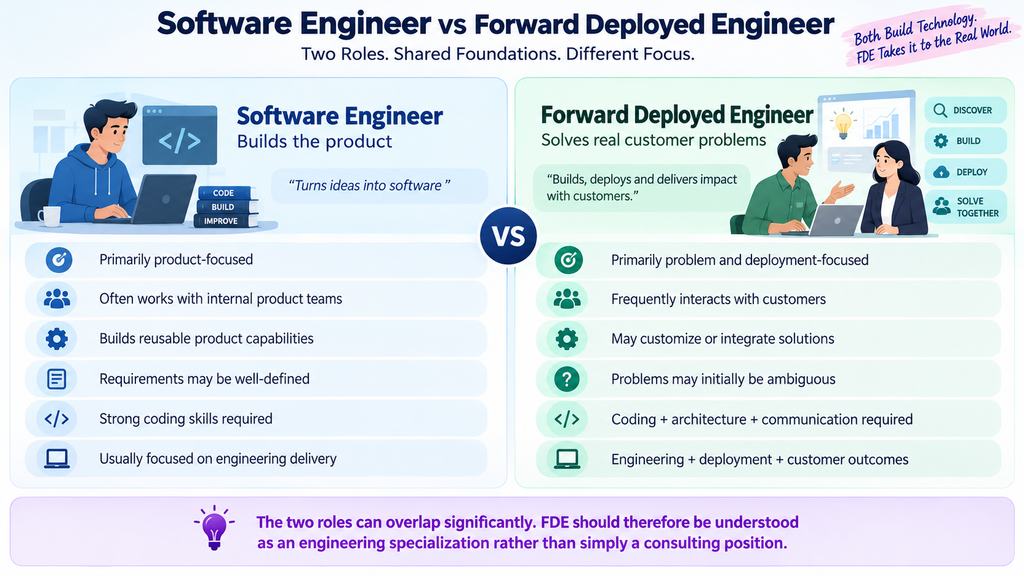
The two roles can overlap significantly. FDE should therefore be understood as an engineering specialization rather than simply a consulting position.
Forward Deployed Engineer vs Solutions Engineer
Another role commonly confused with FDE is Solutions Engineer.
Solutions Engineers frequently help customers understand how a technology or product can solve their problems. Depending on the company, they may be involved in demonstrations, architecture, proof-of-concept development, integrations, and technical sales.
Forward Deployed Engineers generally go deeper into implementation.
An FDE may write production code, develop integrations, create AI pipelines, configure infrastructure, troubleshoot deployments, and continue improving a solution after the initial implementation.
Actual responsibilities vary between employers, so candidates should always examine the job description rather than relying exclusively on the job title.
What Skills Does a Forward Deployed Engineer Need?
A successful Forward Deployed Engineer needs a combination of technical engineering skills and business-facing problem-solving abilities.
1. Programming
Programming is fundamental.
Python is particularly valuable because it is widely used across AI, automation, APIs, backend services, and data engineering.
An FDE should understand:
- Python fundamentals
- Object-oriented programming
- Data structures
- Error handling
- Working with libraries
- REST APIs
- JSON
- Authentication
- Backend development
Knowledge of JavaScript, TypeScript, Java, Go, or another backend language can also be valuable depending on the organization.
2. SQL and Data Skills
Most enterprise applications interact with data.
Forward Deployed Engineers should therefore understand:
- SQL
- Relational databases
- Data modelling
- Data transformation
- ETL concepts
- Data validation
- Database integrations
For AI applications, understanding how to prepare and retrieve data can be just as important as understanding the AI model itself.
3. APIs and System Integration
Enterprise software rarely operates independently.
An FDE may need to connect AI applications with CRM systems, databases, internal platforms, cloud services, authentication providers, or third-party APIs.
Important concepts include:
- REST APIs
- Webhooks
- OAuth
- API authentication
- JSON
- Microservices
- Integration patterns
4. Cloud Computing
Forward Deployed Engineers should understand how applications move from a developer’s laptop into a production environment.
Useful cloud and deployment skills include:
- AWS, Azure, or Google Cloud
- Linux
- Docker
- Containers
- CI/CD
- Logging
- Monitoring
- Environment management
- Application deployment
The objective is not necessarily to become a specialist in every cloud platform. It is to understand how modern applications are deployed, monitored, and maintained.
AI Skills for Forward Deployed Engineers
As enterprise AI adoption grows, AI engineering skills are becoming increasingly relevant to FDE work.
Important areas include:
Large Language Models
An FDE working on AI applications should understand LLM capabilities, limitations, prompting, context windows, structured outputs, model selection, latency, and cost considerations.
Retrieval-Augmented Generation (RAG)
RAG enables an AI application to retrieve relevant information from external knowledge sources before generating an answer.
An FDE should understand concepts such as:
- Embeddings
- Chunking
- Vector databases
- Semantic search
- Retrieval
- Reranking
- Context construction
- Evaluation
AI Agents
AI agents can use models together with tools, APIs, databases, and workflows to perform multi-step tasks.
Forward Deployed Engineers increasingly need to understand how agentic applications are designed, constrained, evaluated, and monitored.
AI Evaluation
A prototype that produces impressive answers during a demonstration is not necessarily production-ready.
Engineers should know how to evaluate:
- Accuracy
- Hallucination
- Retrieval quality
- Latency
- Reliability
- Cost
- Security
- User experience
These engineering considerations separate experimental AI applications from systems that can operate reliably in business environments.
Communication Is an FDE Skill
One of the most underestimated Forward Deployed Engineer skills is communication.
An FDE may speak with developers, managers, business users, customers, product teams, security teams, and senior decision-makers.
The engineer needs to ask questions such as:
What problem are we actually solving?
Who will use the solution?
What does success look like?
Which systems must it integrate with?
What are the technical constraints?
What happens when the system fails?
Being able to translate between business requirements and engineering decisions is a major part of the role.
Forward Deployed Engineer Technology Stack
There is no universal FDE technology stack. However, someone preparing for this career can build a strong foundation around:
Programming: Python, JavaScript/TypeScript
Backend: FastAPI, Flask or similar frameworks
Data: SQL, PostgreSQL, data processing
Integration: REST APIs, JSON, OAuth, webhooks
AI: LLM APIs, prompt engineering, embeddings, RAG
AI frameworks: tools for orchestration, retrieval, agents, and evaluation
Infrastructure: Linux, Git, Docker, CI/CD
Cloud: AWS, Azure, or Google Cloud
Production engineering: logging, monitoring, observability, testing, security, and performance
The objective should not be to collect dozens of technologies. A stronger strategy is learning how the components fit together to solve end-to-end business problems.
Forward Deployed Engineer Roadmap for 2026
Someone starting from a programming or IT background can approach FDE preparation in stages.
Stage 1: Strengthen Programming Fundamentals
Start with Python, Git, Linux, SQL, HTTP, and APIs.
Build small applications rather than learning each technology only theoretically.
Stage 2: Learn Backend and Integration Engineering
Learn how to create APIs, work with databases, implement authentication, consume third-party services, and connect multiple systems.
Stage 3: Learn Cloud and Deployment
Learn Docker, cloud fundamentals, CI/CD, environment management, logging, and monitoring.
Deploy your applications publicly or into controlled cloud environments.
Stage 4: Learn Applied AI
Study LLM APIs, prompt engineering, embeddings, vector search, RAG, tool calling, and AI agents.
Focus on building usable applications rather than only studying models.
Stage 5: Learn Production AI Engineering
Study evaluation, observability, security, guardrails, latency, scalability, and cost optimization.
Stage 6: Build Customer-Style Projects
This stage is particularly important.
Instead of building only generic tutorial projects, create applications around realistic business requirements.
FDE Projects You Can Build for Your Portfolio
A strong portfolio demonstrates the ability to move from a problem statement to a deployed solution.
Useful project ideas include:
Enterprise Knowledge Assistant: Build a RAG application that answers questions from company documents while citing the relevant sources.
Customer Support AI Agent: Create an AI assistant that classifies customer requests, retrieves account information through APIs, and recommends or executes appropriate actions.
Sales Intelligence Assistant: Develop a system that combines CRM information, documents, and external data to help sales teams prepare for customer conversations.
Document Processing Workflow: Build an application that extracts information from documents, validates it, stores structured data, and routes exceptions for human review.
Operations Monitoring Assistant: Create an AI-enabled system that analyzes logs or operational data and helps users investigate incidents.
For each project, document the business problem, architecture, technology choices, implementation, deployment, security considerations, evaluation metrics, limitations, and measurable results.
That presentation makes the project considerably more relevant to FDE work.
How to Become a Forward Deployed Engineer in India
There is no single mandatory degree or certification that automatically makes someone a Forward Deployed Engineer.
Candidates can come from backgrounds such as:
- Software development
- AI/ML engineering
- Data engineering
- Cloud engineering
- DevOps
- Solution architecture
- Technical consulting
- Implementation engineering
The most important requirement is developing the ability to solve real customer problems through engineering.
A practical learning path is:
Programming → APIs → Databases → Cloud → Deployment → Applied AI → RAG/Agents → Production Engineering → Customer-Facing Projects
Professionals who prefer structured, project-oriented learning can also consider specialized Forward Deployed Engineer training covering these capabilities in an integrated curriculum.
Forward Deployed Engineer Training in Kolkata
For learners who want structured FDE preparation, AEM Institute in Kolkata offers Forward Deployed Engineer training focused on practical engineering and deployment skills.
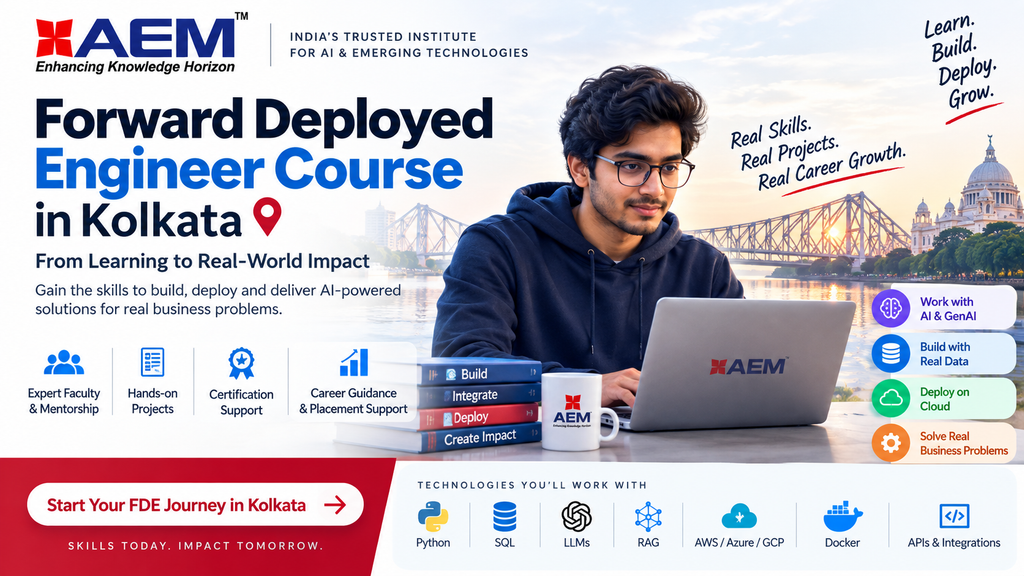
The learning path covers areas such as programming, APIs, databases, cloud technologies, AI engineering, RAG, Agentic AI, deployment, and customer-focused problem solving.
Rather than treating these technologies as isolated subjects, FDE training should teach learners how to combine them to move from:
Business Problem → Technical Architecture → Prototype → Integration → Deployment → Evaluation → Production Solution
Learners looking for structured preparation can explore the Forward Deployed Engineer Course in Kolkata at AEM Institute for curriculum, training format, projects, duration, and course information.
Who Should Learn Forward Deployed Engineering?
FDE training can be relevant for:
- Software developers
- Python developers
- AI and ML professionals
- Cloud engineers
- DevOps engineers
- Data engineers
- Technical consultants
- Solutions engineers
- IT professionals transitioning toward AI
- Engineering graduates with strong programming fundamentals
The role is particularly suited to people who enjoy both building technology and solving customer problems.
Career Opportunities After Learning FDE Skills
Not every organization uses the exact title “Forward Deployed Engineer.”
Therefore, candidates should also investigate related roles such as:
- Forward Deployed Engineer
- Applied AI Engineer
- AI Engineer
- Solutions Engineer
- Implementation Engineer
- AI Solutions Engineer
- Technical Consultant
- Cloud/Platform Engineer
- Solutions Architect
Job titles and responsibilities differ between organizations. When searching for opportunities, focus on the underlying responsibilities and required skills rather than the title alone.
Frequently Asked Questions About Forward Deployed Engineering
What is the full form of FDE?
In this context, FDE stands for Forward Deployed Engineer. An FDE combines engineering expertise with customer-facing problem solving to build and deploy technical solutions in real-world environments.
Is a Forward Deployed Engineer a software engineer?
A Forward Deployed Engineer is an engineering role and often requires strong software development skills. However, FDEs typically work more closely with customers, integrations, deployments, and business requirements than many conventional software engineering positions.
Does an FDE need coding skills?
Yes. Programming is an important FDE competency. Depending on the role, an FDE may write backend applications, APIs, integrations, automation scripts, data pipelines, or AI applications.
Is Python important for Forward Deployed Engineers?
Python is particularly useful for Forward Deployed Engineers working with AI, automation, backend services, APIs, and data. However, the required programming language ultimately depends on the employer and project.
Does an FDE need AI skills?
Not every Forward Deployed Engineer position is exclusively AI-focused. However, knowledge of LLMs, RAG, AI agents, APIs, evaluation, and production AI systems can be highly relevant for FDE roles involving modern enterprise AI solutions.
What should I learn to become a Forward Deployed Engineer?
A strong learning roadmap includes programming, SQL, APIs, backend development, system integration, cloud computing, Docker, deployment, applied AI, RAG, AI agents, observability, security, and customer-facing problem solving.
Can a fresher become a Forward Deployed Engineer?
A fresher can begin preparing for FDE-style work by developing strong software fundamentals and building realistic end-to-end projects. Because many FDE responsibilities require independent engineering and customer interaction, practical project experience is particularly valuable.
Is Forward Deployed Engineering a good career for AI professionals?
FDE can be relevant to AI professionals who want to work on the implementation and deployment side of AI. The role can involve turning AI capabilities into applications that integrate with real data, systems, workflows, and business processes.
Final Thoughts
Forward Deployed Engineering represents a shift from simply building software toward engineering solutions around real customer outcomes.
An FDE needs to understand code, APIs, databases, cloud infrastructure, deployment, and increasingly AI technologies such as RAG and AI agents. At the same time, technical expertise alone is not enough. The engineer must understand business requirements, communicate with stakeholders, make architectural decisions, and deliver systems that work reliably outside a controlled development environment.
For aspiring engineers, the most effective preparation is therefore not learning individual tools in isolation.
Learn how to take a real problem from discovery to architecture, development, integration, deployment, evaluation, and improvement.
That end-to-end engineering mindset is at the heart of Forward Deployed Engineering.
Interested in FDE Course? Enquire on WhatsApp

AI, Cybersecurity & Agentic AI Consultant
AI & Cybersecurity Consultant | Agentic AI & AI Strategy | Responsible AI & AI Ethics | AI Governance | AI Security | Trusted Autonomous Business Solutions | Technology Mentor
With 23+ years of experience in cybersecurity and a growing focus on Artificial Intelligence, Responsible AI, and Agentic AI, I help organizations navigate the intersection of technology, business innovation, security, ethics, and risk.
My consulting focus is evolving from securing infrastructure to helping organizations securely and responsibly adopt AI as a business capability.
I advise organizations on designing and implementing AI-powered and agentic business solutions that can reason, orchestrate workflows, interact with enterprise systems, and execute tasks with appropriate levels of autonomy—while maintaining security, governance, transparency, accountability, and human oversight.
AI Strategy, Ethics & Governance
I help organizations establish practical frameworks for Responsible AI and AI Ethics, addressing questions that go beyond technical performance:
How should AI systems make decisions—and when should humans remain in control?
How do we ensure fairness, transparency, explainability, and accountability?
How do we protect sensitive data and intellectual property when using AI?
How do we manage AI hallucination, model risk, bias, and unintended outcomes?
How do we govern autonomous AI agents operating across enterprise systems?
How do we establish AI policies, controls, risk assessments, and governance models that enable innovation rather than restrict it?
My approach connects AI Ethics, AI Governance, Cybersecurity, Privacy, Risk Management, and Business Strategy into a unified Responsible AI framework.
Agentic AI & Business Transformation
A major area of my consulting interest is Agentic AI—moving beyond conversational AI toward intelligent systems capable of planning, reasoning, collaborating, using tools, and executing multi-step business processes.
I help organizations explore and architect agentic solutions for areas such as:
AI-powered Security Operations and Autonomous SOC
Intelligent incident investigation and response
Enterprise knowledge and decision-support systems
AI-driven IT operations and automation
Customer service and intelligent service orchestration
Business process automation
Risk, compliance, and audit intelligence
Cyber threat intelligence and autonomous analysis
AI-powered enterprise assistants and multi-agent systems
Security and compliance agents integrated into DevSecOps
AI agents for operational and executive decision support
The emphasis is not simply on deploying an AI agent, but on designing an enterprise-grade agentic architecture with the right balance of autonomy, human-in-the-loop controls, security, observability, governance, and measurable business value.
AI Security & Cybersecurity
My cybersecurity background provides the foundation for approaching AI from an adversarial and risk perspective.
I focus on securing the AI lifecycle and AI-enabled enterprise, including:
AI Security → Model Security → Data Security → Agent Security → Identity → Tool/API Security → Runtime Protection → Monitoring → Governance
This includes emerging areas such as AI threat modeling, adversarial AI/ML, prompt injection, model abuse, AI supply-chain risk, agentic AI security, identity and access management for AI agents, and AI-assisted security operations.
Cloud, DevSecOps & AI Engineering
My experience across AWS, Azure, GCP, Kubernetes, IAM, Linux/Windows security, Terraform, GitLab CI/CD, OPA, Checkov, SIEM, digital forensics, and security automation allows me to connect AI initiatives with the underlying enterprise technology ecosystem.
I help bridge the gap between:
Business Strategy ↔ AI Strategy ↔ Agentic AI ↔ Cybersecurity ↔ Governance ↔ Cloud ↔ DevSecOps
My Consulting Mission
I believe the next generation of enterprise transformation will not be defined simply by adopting AI—it will be defined by how responsibly, securely, ethically, and intelligently organizations operationalize AI.
My mission is to help organizations move from:
AI Experimentation → AI Adoption → AI Governance → Agentic AI → Responsible Autonomous Business
while ensuring that human values, business objectives, security, and accountability remain at the center of intelligent automation.
I help organizations turn AI from an emerging technology into a trusted, governed, and business-driven capability.
AI Strategy | Responsible AI | AI Ethics | AI Governance | Agentic AI | AI Security | Cybersecurity Transformation | Cloud & DevSecOps