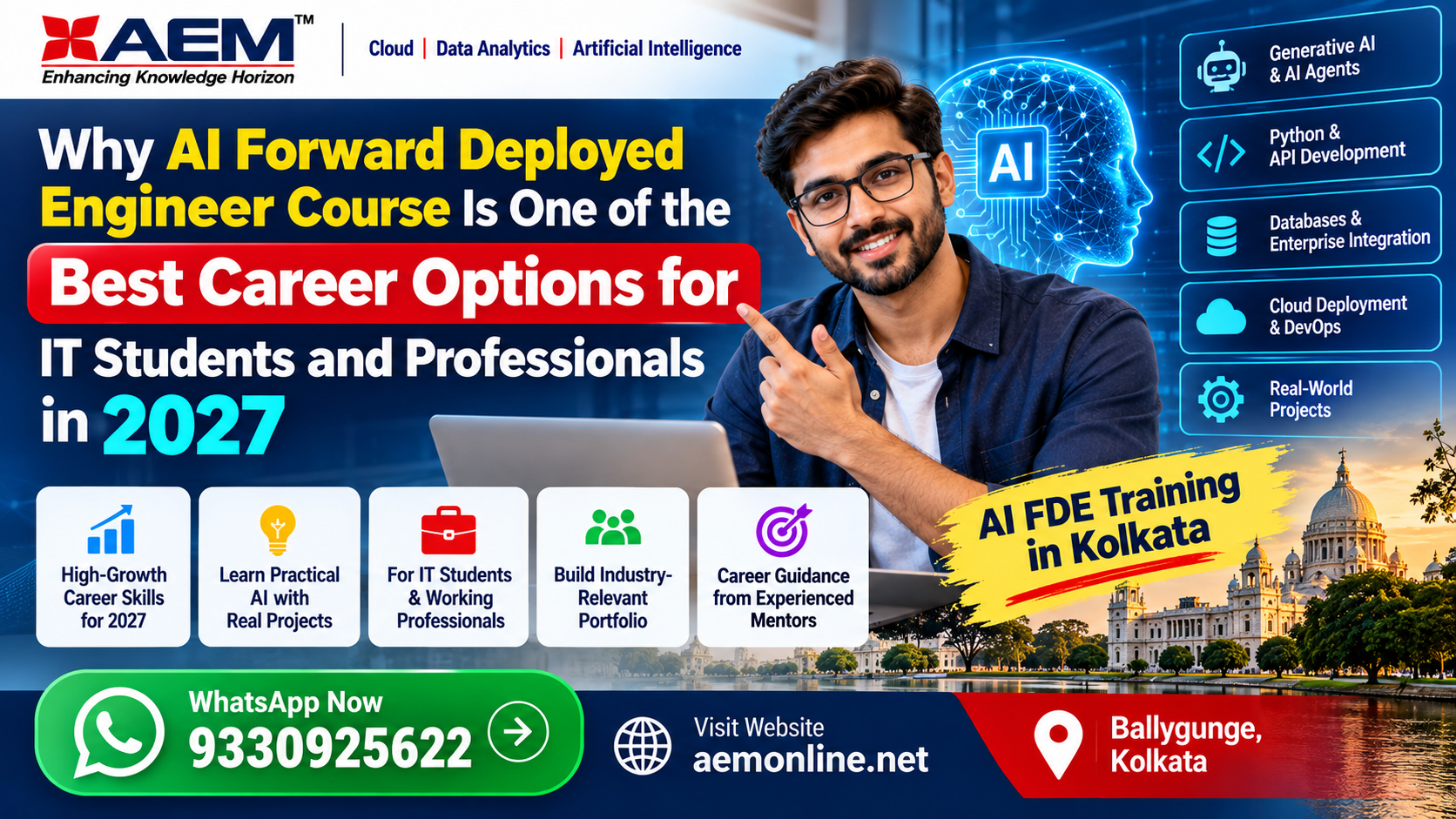
Why AI Forward Deployed Engineer Training Is One of the Best IT Skill Investments for 2027 | AEM Institute Kolkata
Artificial Intelligence is changing how software is developed, integrated, and deployed in businesses. As organizations move from experimenting with AI chatbots to implementing intelligent applications, AI agents, and enterprise automation, a new combination of engineering skills is becoming increasingly valuable.
One of the most relevant emerging specializations is AI Forward Deployed Engineering (AI FDE).
An AI Forward Deployed Engineer does more than develop an AI application. The engineer helps understand real business requirements, connects AI with existing systems, deploys solutions into production, and ensures that the technology works reliably.
For B.Tech, BCA, MCA, and Computer Science students, as well as Python developers, software engineers, cloud professionals, and experienced IT specialists, learning AI FDE skills in 2027 can be a valuable step toward modern AI engineering responsibilities.
AEM Institute, based in Ballygunge, Kolkata, offers a specialized Forward Deployed Engineer course that combines software engineering, Generative AI, Agentic AI, enterprise integration, cloud deployment, and practical projects.
👉 Explore the AI FDE Course at AEM Institute:
1. What Is an AI Forward Deployed Engineer (AI FDE)?
An AI Forward Deployed Engineer is a software-oriented technical professional who works closely with business teams or customers to design, integrate, deploy, and maintain AI-powered solutions in real operational environments.
Unlike AI learning that focuses only on model prompts or demonstrations, AI FDE emphasizes the complete engineering process.
An AI FDE may work on:
- AI-powered business applications
- Generative AI and Large Language Model integration
- Agentic AI and automated workflows
- Retrieval-Augmented Generation (RAG)
- Enterprise APIs and database connectivity
- Cloud deployment and production monitoring
- AI security, reliability, and human approval mechanisms
- Customer requirements and solution delivery
The key difference is practical implementation.
Building an AI chatbot demonstration is one activity. Connecting that chatbot securely to company documents, customer records, business APIs, authentication systems, and monitoring infrastructure is a much broader engineering challenge.
AI Forward Deployed Engineering focuses on that challenge.
2. Why AI FDE Skills Could Become More Important in 2027
The next phase of enterprise AI adoption is expected to place increasing emphasis on implementation, integration, and measurable business outcomes.
Many organizations have already explored Generative AI applications. The more difficult task is making those applications reliable enough for daily business operations.
This creates several important technical requirements.
Moving from AI Demonstrations to Production Applications
A working prototype does not automatically become a production-ready application.
Enterprise AI systems must address authentication, access permissions, data privacy, software integration, error handling, monitoring, and operational reliability.
AI FDE training helps learners understand these requirements as connected engineering responsibilities.
Integrating AI Agents with Business Systems
An AI agent becomes more useful when it can interact with approved software tools and business workflows.
For example, an enterprise AI assistant might retrieve information from an internal knowledge base, check the status of a support request, create a service ticket, or route an issue to a human employee.
Implementing this requires more than prompt engineering. It involves APIs, permissions, data handling, workflow design, testing, and safeguards.
Combining AI Engineering with Cloud Deployment
AI-enabled applications often depend on cloud services, databases, APIs, containers, and monitoring tools.
Professionals who understand both AI application development and production infrastructure can contribute across more stages of implementation.
Solving Business Problems Instead of Only Writing Code
AI FDE responsibilities often include understanding user requirements, selecting an appropriate technical approach, explaining trade-offs, and evaluating the outcome.
These are important skills for engineers who want to work on complete enterprise solutions.
For 2027, the strongest reason to consider AI FDE is not a promise of a particular job title or salary. It is the opportunity to develop a broad, practical skill set relevant to real-world AI deployment.
3. Why AI FDE Training Is Relevant for IT Students in Kolkata
Students pursuing B.Tech, BCA, MCA, and related degrees often learn programming, databases, computer networks, and software engineering as separate subjects.
AI FDE training provides an opportunity to connect these foundations through practical applications.
A student might start by developing a Python application, connecting it to a SQL database, integrating an AI model through an API, and deploying the resulting application to a cloud environment.
The next step is learning how to make the system secure, testable, observable, and useful for a real business process.
This type of project experience can help students:
- Strengthen Python and API development skills
- Understand how enterprise software components interact
- Build practical Generative AI applications
- Learn the fundamentals of AI agents and RAG
- Gain exposure to cloud deployment and monitoring
- Develop portfolio projects that demonstrate technical understanding
- Improve technical problem-solving and project presentation skills
Students should understand that professional Forward Deployed Engineer positions may require significant software engineering experience. Training is a foundation for developing relevant capabilities, not a guarantee of immediate employment in an advanced engineering role.
For aspiring AI engineers in Kolkata, however, it offers a structured way to begin learning how modern AI solutions are implemented.
4. Why Working IT Professionals Should Upgrade to AI FDE Skills
AI Forward Deployed Engineering is particularly relevant to professionals who already have experience in programming, cloud computing, databases, automation, or enterprise applications.
Python and Software Developers
Python developers can expand their knowledge into Generative AI integration, AI agents, enterprise APIs, system architecture, and production deployment.
Rather than focusing only on individual application features, they can learn how complete AI-enabled solutions are designed and operated.
Cloud and DevOps Professionals
Cloud professionals already understand infrastructure, deployment, networking, and operational reliability.
AI FDE training can help them add application development, AI integration, and intelligent workflow design to those existing capabilities.
Data Engineers and SQL Professionals
Data professionals understand the importance of reliable information systems.
Learning AI FDE concepts can help them explore enterprise data integration, retrieval systems, AI applications, and secure connections between data platforms and intelligent software.
AI and Machine Learning Professionals
AI/ML professionals may already understand model development and evaluation.
AI FDE training can complement that expertise with production integration, APIs, infrastructure, security, monitoring, and customer-facing solution delivery.
Technical Consultants and Enterprise Application Professionals
Professionals who work with business requirements and software implementation can benefit from deeper technical skills in AI-enabled applications and automation.
The objective is not necessarily to change careers immediately. It is to develop additional engineering capabilities relevant to AI-driven enterprise projects.
5. What Will You Learn in AEM Institute’s AI FDE Course?
AEM Institute’s Forward Deployed Engineer course in Kolkata brings together software engineering foundations, enterprise integration, cloud technologies, and modern AI application development.
The training is structured around interconnected learning areas rather than treating every technology as an isolated subject.
Module 1: Python, Linux, Git and API Development
Software engineering fundamentals form the foundation of AI FDE.
Learners work with concepts such as Python development, REST APIs, debugging, testing, version control, and Linux environments.
These skills are important because AI applications must still be engineered as reliable software systems.
Module 2: SQL, Databases and Enterprise Integration
Enterprise AI applications frequently interact with databases and existing business systems.
This learning area addresses SQL, data modeling, database queries, authentication, APIs, webhooks, and integration workflows.
The objective is to understand how an AI-enabled application can exchange information with other software systems.
Module 3: Cloud Deployment and Production Engineering
Building an application locally is only part of the engineering process.
The course introduces production-oriented concepts such as Docker, cloud infrastructure, identity and access management, CI/CD, logging, monitoring, and observability.
These topics help learners understand how applications are deployed, maintained, and troubleshot.
Module 4: Generative AI, RAG and Tool Calling
Generative AI becomes more useful when it can work with business-specific information and approved external tools.
This area explores Large Language Models, Retrieval-Augmented Generation, enterprise knowledge retrieval, tool calling, and AI evaluation.
Learners develop an understanding of how to connect AI capabilities with practical application requirements.
Module 5: Agentic AI, Security and Reliability
Agentic AI introduces workflows in which AI-enabled systems can interact with tools and perform defined tasks.
However, enterprise AI agents require appropriate safeguards.
Important concepts include access controls, approval mechanisms, monitoring, reliability, and responsible handling of sensitive information.
Module 6: Customer Requirements, System Design and Project Delivery
Forward Deployed Engineering also requires the ability to translate business problems into working technical solutions.
This learning area connects requirements analysis, architecture, implementation choices, technical communication, and practical project work.
👉 View the complete course syllabus:
6. Practical Example: Building an Enterprise AI Support Assistant
To understand why AI FDE training is different from learning only prompt engineering, consider a practical business scenario.
A company wants an AI assistant that helps employees find information from internal documents and perform selected support operations.
A simple chatbot might answer general questions. A production-oriented enterprise assistant requires much more.
An AI Forward Deployed Engineer would approach the problem in several stages.
First, the engineer identifies what employees need, which documents are relevant, and which business systems the assistant must access.
Second, the engineer develops an application that can retrieve information from approved documents using a RAG-based architecture.
Third, the application is connected to selected enterprise APIs so that it can retrieve permitted information or initiate approved workflows.
Fourth, authentication and authorization are implemented to ensure users can access only the information they are entitled to see.
Fifth, the engineer introduces testing, evaluation, error handling, logging, and human approval steps for sensitive actions.
Finally, the application is deployed and monitored to evaluate reliability, response quality, and operational performance.
This example illustrates the combination of AI, software engineering, databases, cloud infrastructure, security, and business requirements that makes AI FDE a distinctive specialization.
It is an illustrative industry scenario, not a claim that this exact application is included in AEM Institute’s course.
7. Why Practical AI FDE Projects Matter in 2027
The ability to explain a technology is different from the ability to implement it.
For AI engineering, practical projects provide an opportunity to demonstrate how different technical components work together.
AEM Institute’s published FDE curriculum includes three portfolio project areas:
Project 1: Data-to-Decision Application
This project area focuses on transforming business data into useful information and application functionality.
It helps connect database, software, and business-oriented engineering concepts.
Project 2: Enterprise Integration System
This project area emphasizes connecting applications and services through APIs and integration workflows.
It reflects the practical challenges involved in enterprise software environments.
Project 3: Production-Grade Agentic AI Workflow
This project area brings together AI agents, integration, deployment, and operational considerations.
The focus is on understanding how intelligent workflows can be designed with reliability and appropriate safeguards.
For learners, these project areas provide opportunities to develop a portfolio that demonstrates more than familiarity with individual AI tools.
A useful engineering portfolio should explain the problem, architecture, implementation decisions, testing approach, limitations, and results.
8. Why Choose AEM Institute for AI Forward Deployed Engineer Training in Kolkata?
AEM Institute is based in Ballygunge, Kolkata, and provides training in cloud computing, data analytics, and artificial intelligence.
Its Forward Deployed Engineer program is designed for learners who want to understand the practical implementation of AI-enabled enterprise solutions.
Integrated AI and Software Engineering Curriculum
The course combines programming, APIs, databases, cloud deployment, Generative AI, Agentic AI, and solution delivery.
This integrated approach is particularly relevant because production AI applications depend on several technologies working together.
Focus on Real-World Implementation
The course includes practical portfolio project areas that connect technical concepts with business-oriented engineering scenarios.
Production Engineering Concepts
Security, deployment, monitoring, and reliability are important components of the learning path.
These topics distinguish production-focused AI engineering from training that concentrates only on demonstrations.
Technical Mentorship
The institute’s published course information identifies Devraj Sarkar as the lead trainer, with a background in cybersecurity, cloud computing, enterprise technology, and AI-related consulting.
Classroom and Live Online Training
Learners can explore classroom training in Ballygunge, Kolkata, as well as live interactive online learning options.
This provides flexibility for students and working professionals in Kolkata, Salt Lake Sector V, New Town, Rajarhat, and other locations.
Prospective learners should confirm current batch schedules and delivery arrangements with the institute.
9. AI FDE Course in Kolkata: Duration, Fees and Training Details
AEM Institute publishes the following details for its Forward Deployed Engineer program:
| Course Information | Details |
|---|---|
| Course Name | Forward Deployed Engineer (FDE) |
| Institute | AEM Institute |
| Duration | 6 months |
| Structured Training | 50 hours, including project work |
| Published Course Fee | ₹48,950 |
| Training Modes | Classroom and Live Interactive Online |
| Location | 82 Kankulia Road, Ballygunge, Kolkata – 700029 |
| Website | www.aemonline.net |
| 9330925622 |
The institute also advertises a no-cost EMI option for eligible learners. Current fees, payment eligibility, schedules, and admission terms should be reconfirmed before enrollment.
👉 Official course details:
10. Who Should Enroll in an AI Forward Deployed Engineer Course?
AI FDE training may be particularly suitable for:
- B.Tech, BCA, MCA, and Computer Science students with programming fundamentals
- Python developers interested in AI application engineering
- Software engineers seeking experience with enterprise AI integration
- Cloud and DevOps professionals interested in AI-enabled systems
- Data engineers exploring AI application integration
- AI/ML enthusiasts who want to understand production deployment
- IT consultants interested in technical solution implementation
- Working professionals planning to expand their AI engineering capabilities
Learners should be comfortable developing programming and problem-solving skills. Those without a technical foundation may need additional preparation before progressing to advanced integration and deployment topics.
11. Frequently Asked Questions About AI FDE Training in Kolkata
What is an AI Forward Deployed Engineer?
An AI Forward Deployed Engineer designs, integrates, deploys, and maintains AI-enabled solutions for practical business requirements. The role combines software engineering, enterprise integration, cloud technologies, AI application development, and communication with stakeholders.
Is AI Forward Deployed Engineering a promising specialization for 2027?
Yes, it is a promising specialization to explore because businesses need engineering skills to move AI applications from prototypes into operational systems. However, future hiring demand varies by employer, industry, location, and economic conditions.
Is AI FDE training suitable for B.Tech, BCA and MCA students?
Yes. Students with programming fundamentals can use AI FDE training to develop skills in Python, APIs, databases, Generative AI, cloud deployment, and practical software projects.
Can a working software developer learn AI FDE?
Yes. Software developers can build on their existing programming experience by learning AI integration, Agentic AI workflows, enterprise systems, cloud deployment, and production engineering.
What is the difference between AI FDE and prompt engineering?
Prompt engineering focuses on designing effective interactions with AI models. AI FDE is broader and includes application development, enterprise integration, security, deployment, monitoring, and business problem-solving.
Does AI FDE involve Agentic AI?
AI-focused FDE work can involve Agentic AI, particularly when applications use AI models to interact with tools, APIs, and defined business workflows. Such systems require careful access controls, evaluation, and reliability engineering.
Where can I learn AI Forward Deployed Engineering in Kolkata?
AEM Institute offers Forward Deployed Engineer training at 82 Kankulia Road, Ballygunge, Kolkata – 700029, with classroom and live interactive online learning options.
What is the duration of AEM Institute’s FDE course?
The published duration is six months, with 50 hours of structured training including project work.
What is the fee for AEM Institute’s FDE course?
The published course fee is ₹48,950. Contact AEM Institute to confirm current pricing and payment options.
Does completing an AI FDE course guarantee a job?
No. Employment depends on a learner’s technical ability, prior experience, project portfolio, interview performance, and employer requirements. Training can help develop relevant skills but does not guarantee placement.
12. Conclusion: Why AI FDE Training Deserves Attention in 2027
Artificial Intelligence is becoming increasingly integrated with software applications, enterprise systems, and business operations.
As organizations seek to turn AI capabilities into dependable solutions, engineering skills involving APIs, databases, cloud infrastructure, security, AI agents, and production deployment become especially relevant.
This makes AI Forward Deployed Engineering an attractive learning direction for technically inclined students and professionals.
For students, AI FDE training can help connect academic programming knowledge with practical engineering projects.
For experienced IT professionals, it can provide a structured path to expand into AI-enabled enterprise applications and end-to-end solution delivery.
AEM Institute’s Forward Deployed Engineer course in Kolkata combines these disciplines through an integrated curriculum and practical project areas.
For learners seeking a specialized AI engineering course rather than isolated tutorials, it is a program worth exploring.
Enroll in AI Forward Deployed Engineer Training at AEM Institute, Kolkata
🚀 Build practical skills in Generative AI, Agentic AI, Python, APIs, cloud deployment, and enterprise integration.
🎓 Explore the Forward Deployed Engineer training program at AEM Institute.
📍 AEM Institute
82 Kankulia Road, Ballygunge
Kolkata – 700029, West Bengal, India
📲 WhatsApp: 9330925622
🌐 Website: https://www.aemonline.net
👉 View Course Curriculum, Fees and Enrollment Details:
𝐀𝐄𝐌 𝐈𝐧𝐬𝐭𝐢𝐭𝐮𝐭𝐞 – 𝐄𝐧𝐡𝐚𝐧𝐜𝐢𝐧𝐠 𝐊𝐧𝐨𝐰𝐥𝐞𝐝𝐠𝐞 𝐇𝐨𝐫𝐢𝐳𝐨𝐧
Cloud | Data Analytics | Artificial Intelligence
Enquire on WhatsApp
AI, Cybersecurity & Agentic AI Consultant
Cloud Security Architect | DevSecOps Consultant | Certified ISO/IEC 42001 AIMS Lead Auditor | ISO/IEC 27001 ISMS Lead Auditor
With 23+ years in cybersecurity, including Cloud Security Architecture and DevSecOps consulting experience, I help organizations turn AI into a secure, responsible, and business-driven capability.
My focus spans AI Strategy, Agentic AI, Responsible AI, AI Governance, and AI Security, supported by knowledge of India’s Digital Personal Data Protection (DPDP) Act.
I help design trusted AI solutions that balance autonomy, human oversight, privacy, and accountability—connecting intelligent automation with measurable business value.
Secure AI. Responsible autonomy. Business impact.