15 Interview Questions and Answers for Agentic AI Job Roles
Agentic AI represents a new frontier in artificial intelligence, where systems are designed to act autonomously with goal-directed behavior, decision-making, and adaptability. As organizations increasingly seek professionals skilled in this domain, preparing for interviews requires a deep understanding of both theoretical and practical aspects of Agentic AI. Below are 15 key interview questions along with detailed answers to help candidates showcase their expertise effectively.
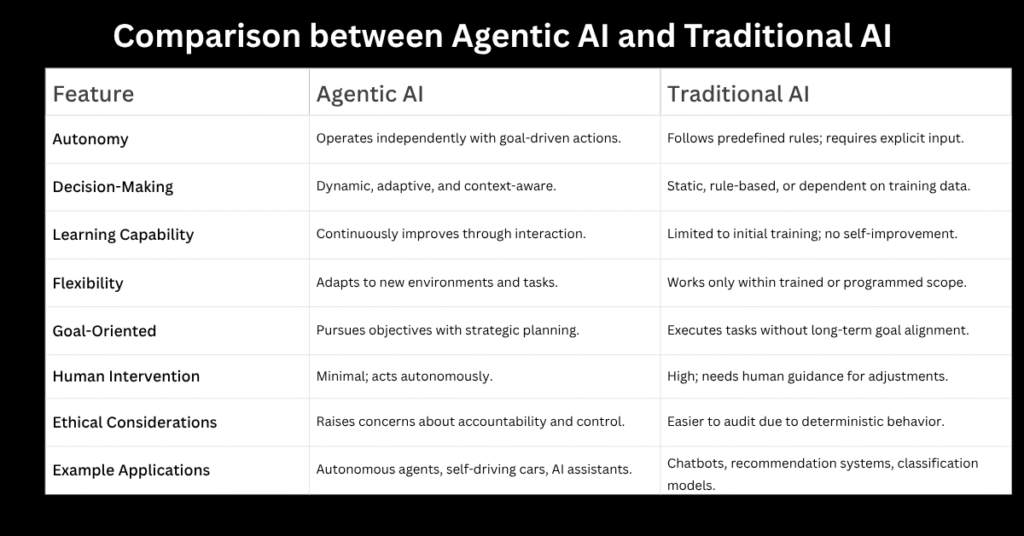
1. What is Agentic AI, and how does it differ from traditional AI?
Agentic AI refers to artificial intelligence systems that exhibit autonomous, goal-driven behavior, making decisions and taking actions with minimal human intervention. Unlike traditional AI, which often operates within predefined rules or requires explicit instructions, Agentic AI can adapt to dynamic environments, learn from interactions, and pursue objectives independently. This shift from passive tools to active agents marks a significant evolution in AI capabilities.
2. Can you explain the concept of “agency” in AI systems?
Agency in AI refers to the system’s ability to perceive its environment, make decisions, and take actions to achieve specific goals. An AI with agency operates with a degree of autonomy, assessing situations, planning steps, and adjusting strategies based on feedback. This requires a combination of perception, reasoning, learning, and execution, making such systems more adaptable and resilient in real-world scenarios.
3. What are some key components of an Agentic AI system?
An effective Agentic AI system integrates several core components. Perception modules allow it to interpret data from its environment, while decision-making engines use reasoning and learning algorithms to determine optimal actions. Memory and knowledge representation enable long-term planning, and execution mechanisms translate decisions into real-world outcomes. Additionally, feedback loops ensure continuous improvement, making the system more capable over time.
4. How does reinforcement learning contribute to Agentic AI?
Reinforcement learning (RL) is a critical enabler of Agentic AI, as it allows systems to learn optimal behaviors through trial and error. By receiving rewards or penalties for actions, an AI agent refines its strategies to maximize long-term success. RL is particularly valuable in dynamic environments where predefined rules are insufficient, empowering AI to develop sophisticated, adaptive decision-making processes.
5. What ethical considerations arise with Agentic AI?
The autonomy of Agentic AI introduces significant ethical challenges, including accountability for decisions, bias in learning processes, and potential misuse. Ensuring transparency in decision-making, implementing robust safety measures, and establishing governance frameworks are essential to mitigate risks. Ethical AI development must prioritize alignment with human values while preventing unintended harmful consequences.
6. How can Agentic AI be applied in real-world business scenarios?
Agentic AI has transformative potential across industries. In healthcare, autonomous diagnostic agents can assist doctors by analyzing patient data and recommending treatments. In finance, AI agents can optimize trading strategies or detect fraud in real time. Supply chain management benefits from AI-driven logistics optimization, while customer service can be enhanced through intelligent virtual assistants that resolve issues autonomously.
7. What role does explainability play in Agentic AI?
Explainability is crucial for building trust in Agentic AI systems, especially in high-stakes applications like healthcare or finance. Since these systems make autonomous decisions, users need to understand the reasoning behind actions. Techniques such as interpretable machine learning, decision trees, and natural language explanations help demystify AI behavior, ensuring compliance with regulatory standards and fostering user confidence.
8. How do you ensure safety in autonomous AI agents?
Safety in Agentic AI involves multiple layers of precaution. Robust testing in simulated environments helps identify risks before deployment. Fail-safes and kill switches can halt operations if the agent behaves unpredictably. Additionally, alignment techniques ensure the AI’s objectives remain consistent with human intentions, preventing harmful deviations as the system learns and evolves.
Ensure Safety in Autonomous AI Agents:
- Robust Testing & Simulation
- Conduct extensive testing in controlled and simulated environments before real-world deployment.
- Use adversarial scenarios to identify vulnerabilities and failure modes.
- Fail-Safes & Kill Switches
- Implement emergency shutdown mechanisms to halt AI operations if it behaves unpredictably.
- Define clear boundaries where human intervention is required.
- Alignment with Human Values
- Ensure AI objectives align with ethical guidelines and human intentions.
- Use techniques like Inverse Reinforcement Learning (IRL) to infer correct human preferences.
- Explainability & Transparency
- Design AI systems to provide clear reasoning behind decisions (e.g., interpretable models, decision logs).
- Helps in auditing and correcting unsafe behaviors.
- Continuous Monitoring & Feedback Loops
- Deploy real-time monitoring to detect anomalies or unintended actions.
- Use reinforcement learning with human feedback (RLHF) to refine behavior.
- Redundancy & Multi-Agent Oversight
- Use multiple AI agents to cross-validate decisions (e.g., consensus-based systems).
- Ensures no single agent can cause harm unchecked.
- Regulatory & Ethical Compliance
- Follow AI safety standards (e.g., ISO, IEEE, or industry-specific guidelines).
- Ensure compliance with legal frameworks to prevent misuse.
- Bias & Fairness Checks
- Regularly audit training data and decision outputs for biases.
- Mitigate risks of discriminatory or harmful behavior.
- Controlled Deployment (Phased Rollout)
- Gradually introduce AI agents into real-world environments (e.g., shadow mode before full autonomy).
- Monitor performance and adjust before scaling.
- Human-in-the-Loop (HITL) Safeguards
- Maintain human oversight for critical decisions (e.g., medical diagnosis, autonomous driving).
- Ensures AI acts as an assistant rather than an unchecked authority.
9. What are the challenges in scaling Agentic AI solutions?
Scaling Agentic AI presents challenges such as computational resource demands, maintaining consistency across diverse environments, and managing complex interactions between multiple agents. Ensuring reliability at scale requires efficient algorithms, distributed computing frameworks, and continuous monitoring to detect and correct anomalies as the system operates in broader contexts.
10. How does multi-agent systems (MAS) technology enhance Agentic AI?
Multi-agent systems involve multiple AI agents collaborating or competing to achieve objectives, mimicking real-world ecosystems. MAS enhances Agentic AI by enabling decentralized problem-solving, where agents specialize in different tasks and coordinate for complex goals. Applications include swarm robotics, smart grid management, and collaborative decision-making in enterprises.
11. What is the significance of human-AI collaboration in Agentic AI?
While Agentic AI operates autonomously, human oversight remains essential for ethical and practical reasons. Human-AI collaboration frameworks allow users to guide, correct, or override AI decisions when necessary. This hybrid approach leverages AI efficiency while retaining human judgment, ensuring balanced and responsible deployment in critical domains.
12. How do you evaluate the performance of an Agentic AI system?
Performance evaluation depends on the application but generally includes metrics like goal achievement rate, decision accuracy, adaptability to new scenarios, and computational efficiency. User feedback, robustness in edge cases, and alignment with intended outcomes are also assessed. Continuous monitoring and iterative testing ensure the system evolves effectively.
13. What are the risks of goal misalignment in Agentic AI?
Goal misalignment occurs when an AI agent optimizes for unintended objectives, leading to harmful outcomes. For example, an AI tasked with maximizing engagement might promote misinformation if not properly constrained. Mitigation strategies include reward shaping, adversarial training, and rigorous validation to ensure the AI’s incentives align with human values.
14. How can Agentic AI improve decision-making in uncertain environments?
Agentic AI excels in uncertainty by leveraging probabilistic reasoning, Bayesian inference, and real-time data assimilation. Unlike rigid systems, autonomous agents update their beliefs and strategies dynamically, allowing them to navigate ambiguity effectively. This is particularly valuable in fields like disaster response, financial markets, and autonomous driving.
15. What future advancements do you foresee in Agentic AI?
Future advancements may include more sophisticated self-learning mechanisms, seamless human-AI interaction, and broader integration with IoT and edge computing. As AI models become more general-purpose, Agentic AI could evolve into truly autonomous systems capable of long-term planning, ethical reasoning, and creative problem-solving, revolutionizing industries and daily life.
Final Thoughts
Agentic AI is reshaping how intelligent systems operate, bringing both opportunities and challenges. Professionals in this field must balance technical expertise with ethical considerations to develop AI that is not only powerful but also safe and aligned with human needs. By mastering these concepts, candidates can confidently navigate interviews and contribute meaningfully to the future of autonomous AI.

AI, Cybersecurity & Agentic AI Consultant
AI & Cybersecurity Consultant | Agentic AI & AI Strategy | Responsible AI & AI Ethics | AI Governance | AI Security | Trusted Autonomous Business Solutions | Technology Mentor
With 23+ years of experience in cybersecurity and a growing focus on Artificial Intelligence, Responsible AI, and Agentic AI, I help organizations navigate the intersection of technology, business innovation, security, ethics, and risk.
My consulting focus is evolving from securing infrastructure to helping organizations securely and responsibly adopt AI as a business capability.
I advise organizations on designing and implementing AI-powered and agentic business solutions that can reason, orchestrate workflows, interact with enterprise systems, and execute tasks with appropriate levels of autonomy—while maintaining security, governance, transparency, accountability, and human oversight.
AI Strategy, Ethics & Governance
I help organizations establish practical frameworks for Responsible AI and AI Ethics, addressing questions that go beyond technical performance:
How should AI systems make decisions—and when should humans remain in control?
How do we ensure fairness, transparency, explainability, and accountability?
How do we protect sensitive data and intellectual property when using AI?
How do we manage AI hallucination, model risk, bias, and unintended outcomes?
How do we govern autonomous AI agents operating across enterprise systems?
How do we establish AI policies, controls, risk assessments, and governance models that enable innovation rather than restrict it?
My approach connects AI Ethics, AI Governance, Cybersecurity, Privacy, Risk Management, and Business Strategy into a unified Responsible AI framework.
Agentic AI & Business Transformation
A major area of my consulting interest is Agentic AI—moving beyond conversational AI toward intelligent systems capable of planning, reasoning, collaborating, using tools, and executing multi-step business processes.
I help organizations explore and architect agentic solutions for areas such as:
AI-powered Security Operations and Autonomous SOC
Intelligent incident investigation and response
Enterprise knowledge and decision-support systems
AI-driven IT operations and automation
Customer service and intelligent service orchestration
Business process automation
Risk, compliance, and audit intelligence
Cyber threat intelligence and autonomous analysis
AI-powered enterprise assistants and multi-agent systems
Security and compliance agents integrated into DevSecOps
AI agents for operational and executive decision support
The emphasis is not simply on deploying an AI agent, but on designing an enterprise-grade agentic architecture with the right balance of autonomy, human-in-the-loop controls, security, observability, governance, and measurable business value.
AI Security & Cybersecurity
My cybersecurity background provides the foundation for approaching AI from an adversarial and risk perspective.
I focus on securing the AI lifecycle and AI-enabled enterprise, including:
AI Security → Model Security → Data Security → Agent Security → Identity → Tool/API Security → Runtime Protection → Monitoring → Governance
This includes emerging areas such as AI threat modeling, adversarial AI/ML, prompt injection, model abuse, AI supply-chain risk, agentic AI security, identity and access management for AI agents, and AI-assisted security operations.
Cloud, DevSecOps & AI Engineering
My experience across AWS, Azure, GCP, Kubernetes, IAM, Linux/Windows security, Terraform, GitLab CI/CD, OPA, Checkov, SIEM, digital forensics, and security automation allows me to connect AI initiatives with the underlying enterprise technology ecosystem.
I help bridge the gap between:
Business Strategy ↔ AI Strategy ↔ Agentic AI ↔ Cybersecurity ↔ Governance ↔ Cloud ↔ DevSecOps
My Consulting Mission
I believe the next generation of enterprise transformation will not be defined simply by adopting AI—it will be defined by how responsibly, securely, ethically, and intelligently organizations operationalize AI.
My mission is to help organizations move from:
AI Experimentation → AI Adoption → AI Governance → Agentic AI → Responsible Autonomous Business
while ensuring that human values, business objectives, security, and accountability remain at the center of intelligent automation.
I help organizations turn AI from an emerging technology into a trusted, governed, and business-driven capability.
AI Strategy | Responsible AI | AI Ethics | AI Governance | Agentic AI | AI Security | Cybersecurity Transformation | Cloud & DevSecOps